
Mixed fresh on-site
Batched at your job, so the screed is workable from the first barrow to the last.

Floor screed mixed on-site and laid smooth and level.
Trusted by contractors, councils & developers






We supply and mix floor screed on-site for domestic and commercial floors: sand-cement and specialist screeds, batched to the consistency your floor needs. Because it is mixed volumetrically you get a fresh, consistent screed every time, with no waste.
Batched at your job, so the screed is workable from the first barrow to the last.
Volumetric batching keeps the sand-cement ratio identical across the whole floor.
From a single room to a full commercial floor plate.
Metered by the cubic metre, no leftover screed, no full-load charge.
Traditional screed mixed in batches on the ground varies bay to bay. Volumetric batching keeps the ratio the same from the first barrow to the last, so the floor cures evenly.
Until the old covering is up, nobody knows the depth. Order at your estimate and we mix more if the floor takes it.
A screed job too small for a full drum load. No full-load minimum means a single room is a normal booking, not an awkward one.
Screed is usually quoted per square metre, which hides the fact that depth drives the cost.
Tell us the floor area and the depth in your build-up and we will convert it to cubic metres and price it. Call 0800 001 6147.
We run screed out of three depots. If your site is inside these postcode areas, ring us and we will tell you which depot is closest and roughly how long it takes to reach you.
The things customers ask us most about screed.
Per-m² figures are misleading on their own because depth drives the price: 60m² at 50mm uses the same volume as 30m² at 100mm. We price by the cubic metre actually mixed, so give us the area and the depth from your floor build-up and we will convert it. For most floors the depth comes from whether the screed is bonded, unbonded or floating over insulation.
As a general guide, a bonded screed is around 25–40mm, an unbonded or floating screed around 50–75mm, and screed over insulation thicker again. The controlling figure is your floor build-up and any structural or acoustic requirement, so check the specification for the job rather than working from a rule of thumb.
The usual rule of thumb is about 1mm per day for the first 50mm in good drying conditions, slowing after that. A 75mm screed is therefore weeks, not days, before it is ready for a moisture-sensitive floor covering. Cold or humid conditions extend it considerably. Always confirm with a moisture test before covering.
Screed uses finer aggregate and is designed to be laid thin and finished smooth as a floor surface. Concrete uses coarse aggregate and provides structural strength. Screed goes on top of a structural slab to give a level, workable finish for the floor covering.
Yes. There is no full-load minimum, so a single room is a normal job. The mixer batches what the floor takes and meters it, which is exactly the case where ordering a full drum load makes no sense.
Concrete mixed fresh on your site, metered to the exact volume you pour.
View serviceReady-mix-grade concrete, delivered the smarter way, mixed fresh on your site.
View serviceFast, self-levelling flowing screed, ideal over underfloor heating and large floors.
View service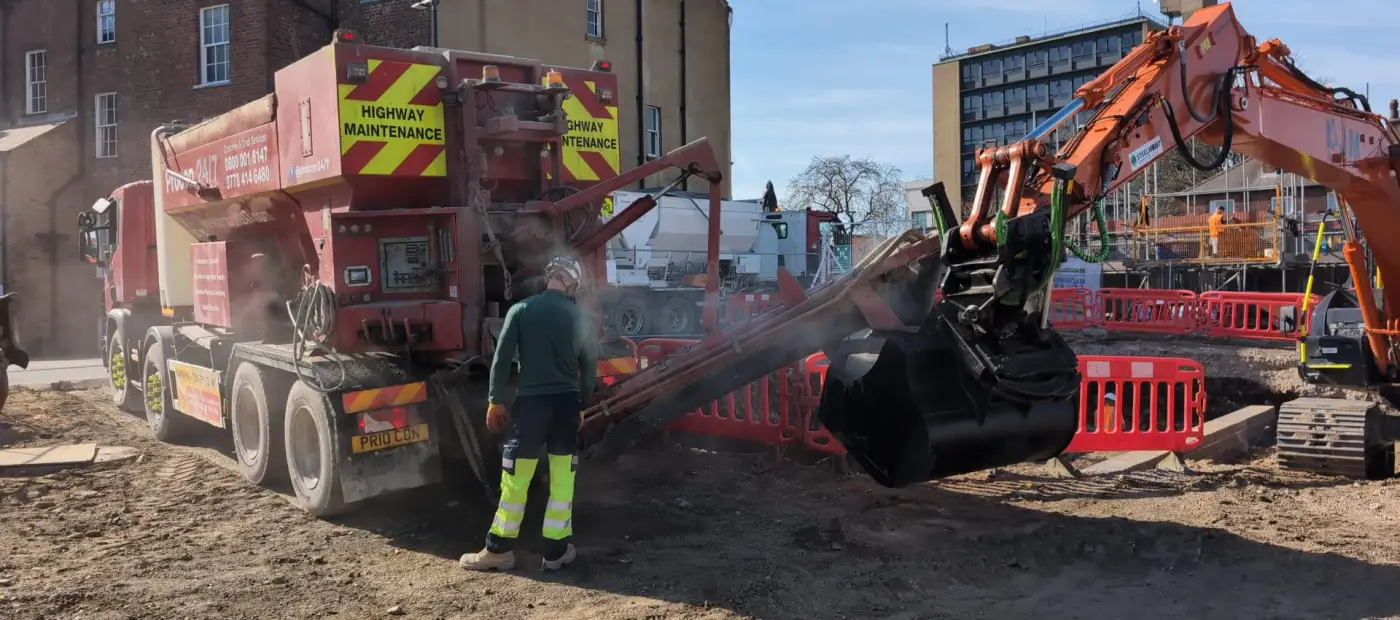
Same-day where we can, fresh every pour, across Yorkshire and the North West.
Leeds · Bradford · York · Sheffield · Wakefield · Manchester · Liverpool · Preston · Huddersfield · Halifax · & every site in between