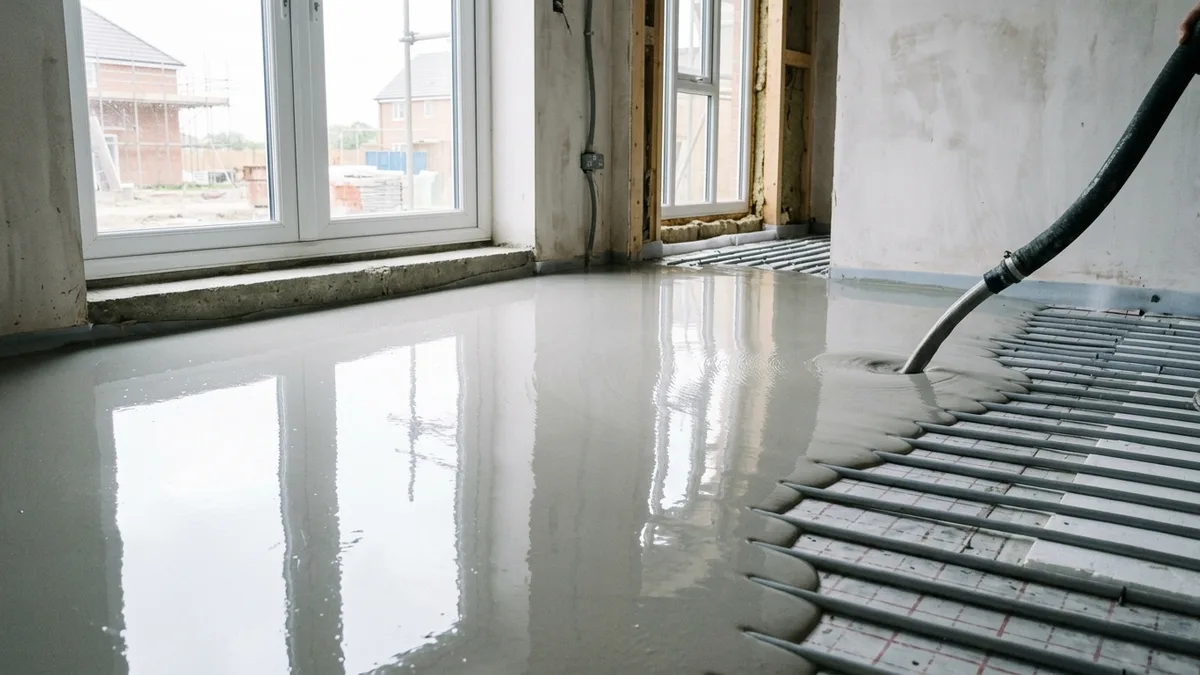
Self-levelling screed, more accurately called liquid screed or flowing screed, is a floor screed fluid enough to spread out and find its own level rather than being laid, tamped and levelled by hand. It is pumped onto the floor, lightly agitated with a dappling bar, and left to settle flat. If you are still weighing up screed against concrete in the first place, our screed vs concrete guide covers that broader comparison.
How Does Self-Levelling Screed Work?
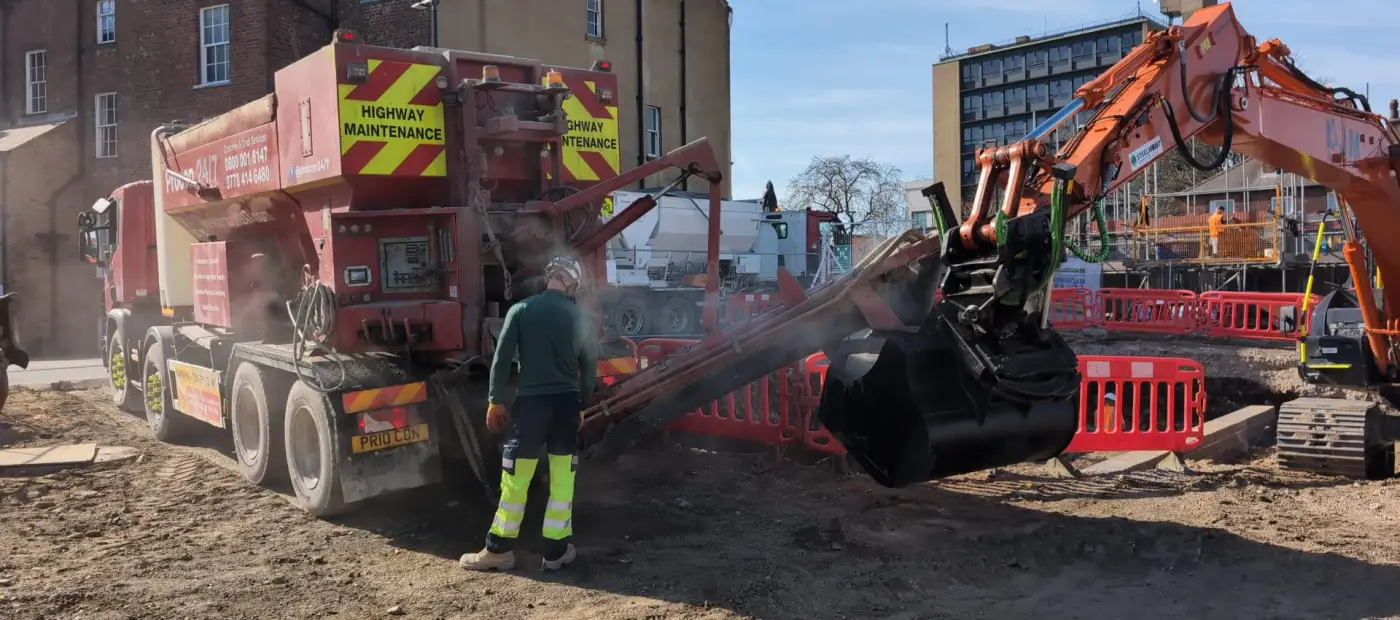
The mix is delivered or batched to a very high flow consistency and pumped through a hose to the floor. Once discharged it spreads under its own weight. The installer passes a dappling bar through it to release trapped air and even out the surface, and that is broadly the extent of the manual work. A team can lay several hundred square metres in a day, against a fraction of that for traditional screed.
Most UK liquid screeds are anhydrite based, using calcium sulfate as the binder rather than cement. That is what allows the thinner build-up and the high flow, and it is also the source of most of the practical differences covered below. Cement-based liquid screeds exist and behave more like traditional screed chemically, but are less common.
Self-Levelling Screed vs Traditional Sand and Cement Screed
The differences that actually drive the decision on site:
- Depth. Liquid screed goes down at 35 to 40mm on insulation, against 65 to 75mm for sand and cement. On a refurbishment where the floor build-up has to fit under an existing door threshold, that 30mm often decides it on its own.
- Speed of laying. Pumped and dappled rather than laid and levelled by hand, so the labour per square metre is dramatically lower.
- Flatness. A liquid screed finds its own level, so it is typically flatter than a hand-laid screed and better suited to large-format tiles and vinyl.
- Drying time. This is where liquid screed loses. Anhydrite screeds dry slowly, roughly a day per millimetre for the first 40mm, so a 40mm screed can need around 40 days before floor coverings go down.
- Moisture sensitivity. Anhydrite is not suitable for permanently wet areas, so wet rooms and similar generally call for a cement-based screed instead.
Why Is Liquid Screed Better for Underfloor Heating?
Underfloor heating is the application where liquid screed most clearly wins. A hand-laid sand and cement screed has to be worked around the pipework, and voids underneath and beside the pipes are difficult to avoid entirely. Air in those voids insulates the pipe from the screed, which is the opposite of what the system needs.
Liquid screed flows fully around and beneath each pipe, giving complete contact along the whole run. The result is better heat transfer and a system that responds faster to the thermostat. The thinner build-up compounds the benefit, because there is less mass to bring up to temperature each time the heating comes on.
Our liquid screed service covers supply and pumping on one order, and the case studies include a domestic Gypsol Classic pour laid at 40mm.
How Long Before You Can Walk On It and Lay Flooring?
These are two different questions and the gap between the answers catches people out.
Foot traffic is usually possible within 24 to 48 hours. Drying to the moisture content that floor finishes require is a much longer process, because the screed has to lose water to the air rather than simply set. The working rule is one day per millimetre for the first 40mm, then slower beyond that, so a 40mm screed needs roughly 40 days in normal conditions.
Force drying using the underfloor heating itself can shorten this substantially, following a controlled commissioning cycle that ramps the temperature up gradually rather than switching it on fully. Whatever the schedule, the moisture level should be measured before a floor covering goes down rather than assumed from the calendar. Trapping moisture under an impermeable covering is how screeds ruin the finish they were laid to support.
What Preparation Does an Anhydrite Screed Need Before Flooring?
Anhydrite screeds develop a layer of fine laitance on the surface as they cure. It must be removed, normally by sanding, before any adhesive or covering is applied, otherwise the finish bonds to a weak surface layer rather than to the screed itself.
Two further points specific to anhydrite: it needs an appropriate primer, and it is not automatically compatible with cement-based tile adhesives, because calcium sulfate can react with cement to form expansive compounds. Use the adhesive the screed manufacturer specifies rather than the one already on the van.
Is Self-Levelling Screed Worth the Cost?
Per square metre the material generally costs more than sand and cement. The comparison that matters is the installed cost, where much faster laying and far less labour usually close the gap, and the programme cost, where the thinner build-up can save an entire sequence of work on a refurbishment.
Against that, the drying time is a real programme constraint that has to be planned for rather than discovered. On a new build with a long enough run-in it is rarely a problem. On a fast refurbishment with flooring following close behind, it can be the deciding factor the other way.
For the traditional alternative see our sand and cement screed service, and for a related flowing material used structurally rather than as a floor finish, see the self-compacting concrete price guide. Tell us the area and depth on 0800 001 6147 and we will price the screed and the pump together.
Can liquid floor screed be laid on any surface?
No. It needs a sound, clean, suitably prepared substrate. It is laid over concrete slabs, insulation boards and beam-and-block floors, either bonded, unbonded on a membrane, or floating over insulation. What it cannot do is bond to a dusty, contaminated, damp or unstable base, so preparation and the correct primer for the substrate decide whether it performs. Timber floors need specific products and confirmation the structure can carry the added weight.