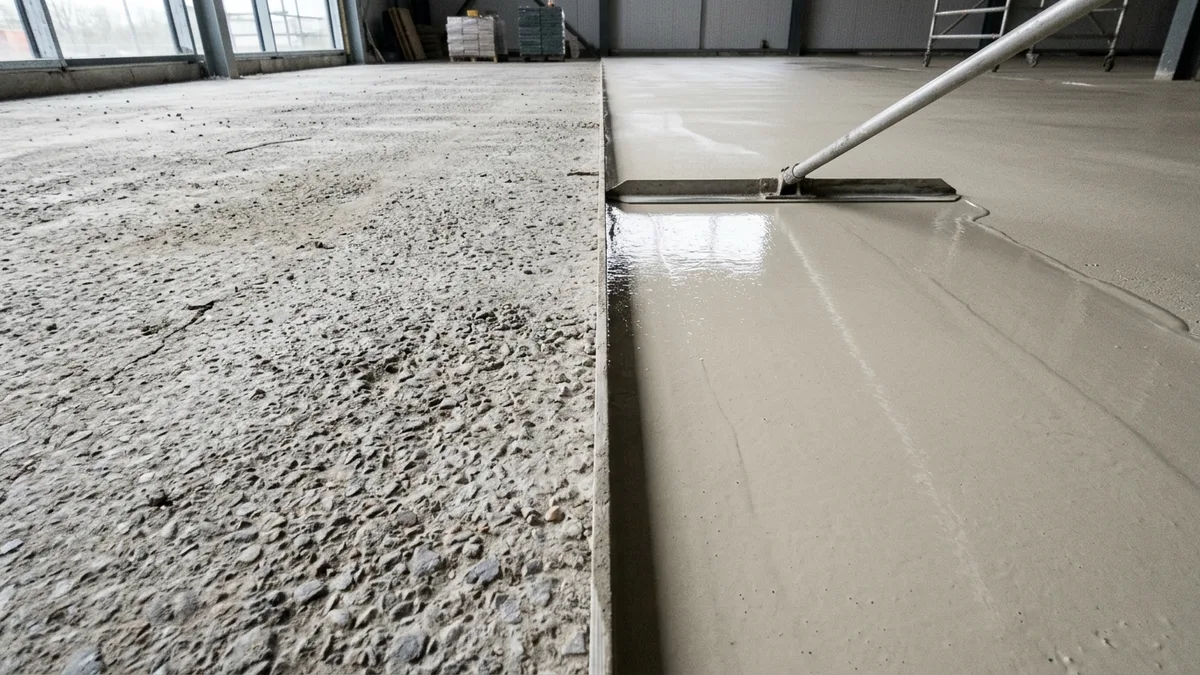
Screed and concrete both start from cement, aggregate and water, and on a job site people use the words almost interchangeably. They are not the same material and they do different jobs in a floor build-up: concrete is the structural base, screed is the level, workable layer on top that a floor covering goes down on.
What's Actually Different Between Them
The difference comes down to aggregate size and the job each layer is built to do.
Concrete uses coarse aggregate, gravel and crushed stone up to 20mm or more, mixed for compressive strength. It carries the structural load of a slab, foundation, driveway or floor and is poured at 100mm or more.
Screed uses a much finer aggregate, sharp sand under about 4mm, and is designed to be laid thin, flat and smooth. It is not built to carry structural load on its own. A screed floor is almost always screed on top of a structural concrete slab, not screed instead of one.
Think of it as two jobs in sequence: concrete does the strength, screed does the finish.
Is Screed Cheaper Than Concrete?
Not per cubic metre, usually. Screed's finer, more consistent aggregate and tighter batching spec tend to price above standard structural concrete on a like-for-like volume basis. But that comparison is misleading on its own, because screed goes down at a fraction of the thickness a structural slab needs, 25-75mm against 100mm or more for concrete.
Cost the actual job rather than the per-m3 rate: a screed floor's material cost is driven by area x depth, and 40mm of screed over 30m2 is a genuinely small volume next to a 150mm driveway slab over the same footprint. Use our concrete calculator to convert your area and depth into volume before comparing prices on either material.
Is Floor Screed as Strong as Concrete?
No, and it does not need to be. Screed is not carrying the building's load, the slab beneath it is. Screed needs to be hard-wearing enough for foot traffic and whatever finish sits on it, not structurally load-bearing in its own right.
This is the mistake behind most of the confusion between the two materials: asking whether screed is 'as strong as' concrete is really asking two different questions about two different jobs. If a floor genuinely needs structural strength (a warehouse floor taking racking or forklift traffic, for example) that strength comes from the concrete slab and its reinforcement, not from a thicker screed on top. Our reinforcement guide covers how that strength is designed in.
Can You Screed Straight Onto Concrete?
Yes, this is the standard bonded-screed method and the most common way a screed floor is built. The sequence:
- Prepare the slab. The concrete needs to be sound, clean and free of laitance, dust, oil or curing compound. A mechanically roughened or scabbled surface bonds better than a smooth power-floated one.
- Prime it. An SBR or similar bonding agent goes on the prepared concrete, usually diluted and brushed or rolled across the whole area.
- Lay the screed while the primer is still tacky. This is what actually creates the bond between the two layers, get the timing wrong and the screed can debond and hollow-sound underfoot later.
Where full bonding is not wanted, an unbonded screed goes down on a polythene separating membrane instead, or a floating screed sits on insulation boards, most commonly over underfloor heating. Which method is right depends on the floor build-up, not a fixed rule.
How Thick Should a Screed Floor Be?
It depends on how it is laid:
- Bonded sand-cement screed: 25-40mm, bonded directly to the prepared slab.
- Unbonded or floating sand-cement screed: 50-75mm, on a membrane or insulation.
- Liquid self-levelling screed: 35-40mm on insulation, thinner again than a hand-laid floating screed for the same job. Our self-levelling screed guide covers this in depth, including why it has become the default over underfloor heating.
Going thinner than the minimum for the method risks cracking and insufficient cover over any pipework; going needlessly thick adds cost and drying time for no benefit.
Can You DIY a Screed Floor?
A small sand-cement screed, a single room or a shed base, is within reach of a competent DIYer, but it punishes inconsistency more than most people expect. Too wet and the screed weakens and takes longer to dry; too dry and it will not compact properly and dusts on the surface. Getting an even fall and a flat level across a room by hand, working against the clock before the mix goes off, is harder in practice than the how-to videos make it look.
Liquid self-levelling screed is not a realistic DIY job. It needs pumping equipment, a mixed batch delivered to a specific flow consistency, and a dappling bar pass to release trapped air while it is still workable, that is specialist plant and know-how, not a wheelbarrow job.
Common Screeding Mistakes
The four that account for most screed floor problems, in order of how often they show up:
- Poor substrate preparation. Laying onto a dusty, contaminated or unprimed slab is the single biggest cause of a screed debonding and hollow-sounding later.
- Wrong mix consistency. Too wet weakens the cured screed and stretches drying time considerably; too dry stops it compacting and finishing properly.
- Skipping movement joints. A large screed floor poured as one continuous slab without joints will crack as it dries and shrinks, joints let that movement happen in controlled, invisible places instead.
- Covering it too soon. Laying a floor finish before the screed has actually dried to the moisture level that finish requires, guessed from the calendar rather than confirmed with a moisture test, is how a screed ruins the covering it was laid to support. Our self-levelling screed guide has the drying-time detail for liquid screeds specifically.
Is Screed Just Sand and Cement?
Traditional screed is, but it is not the only option. Liquid self-levelling screed is usually anhydrite based (calcium sulfate rather than cement), which is what lets it flow, go down thinner and cure on a different timeline. Fibre-reinforced and polymer-modified screeds add strength or faster turnaround for specific jobs. Which one is right depends on the floor build-up, the programme and whether underfloor heating is involved, not a single default recipe.
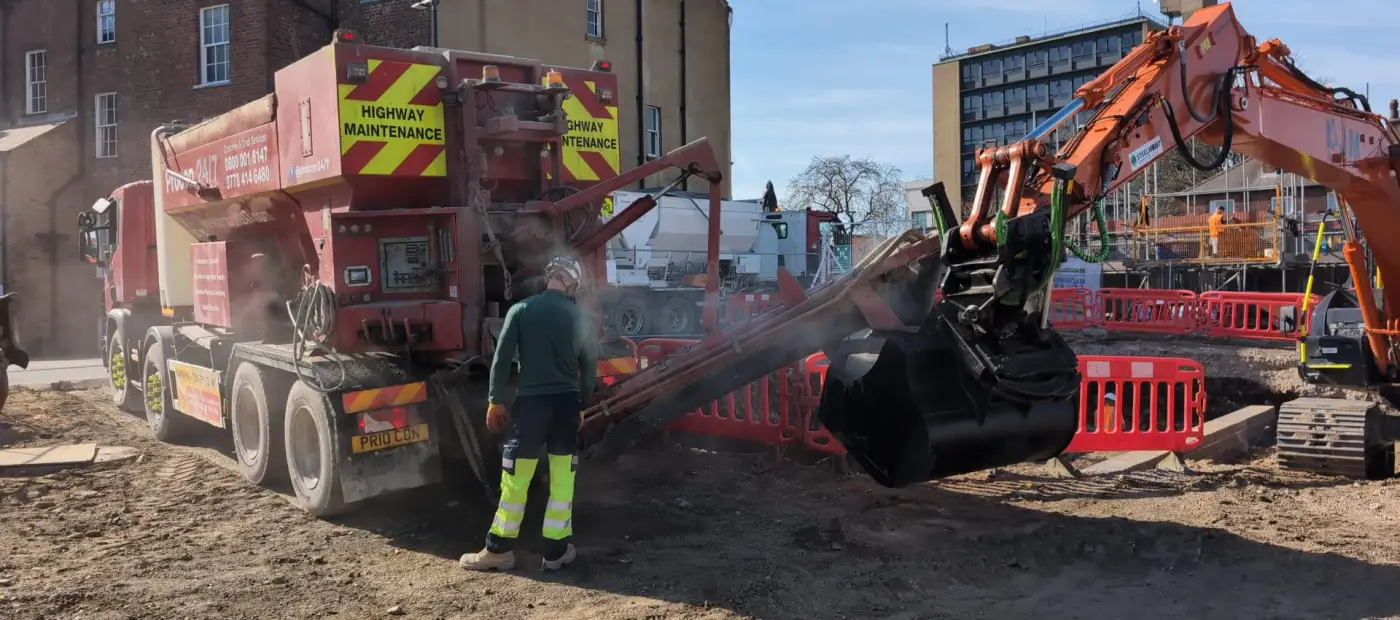
We supply and mix both sides of this on-site: sand-cement and specialist floor screed and liquid self-levelling screed, batched fresh so you pay for what the floor actually takes rather than a full-load minimum. Tell us the area and depth on 0800 001 6147 and we will price the concrete base and the screed together.