
Batched to your density
Mixed on site to the figure on your specification, anywhere from 400 to 1600 kg/m³, rather than to whatever a plant produced that morning.
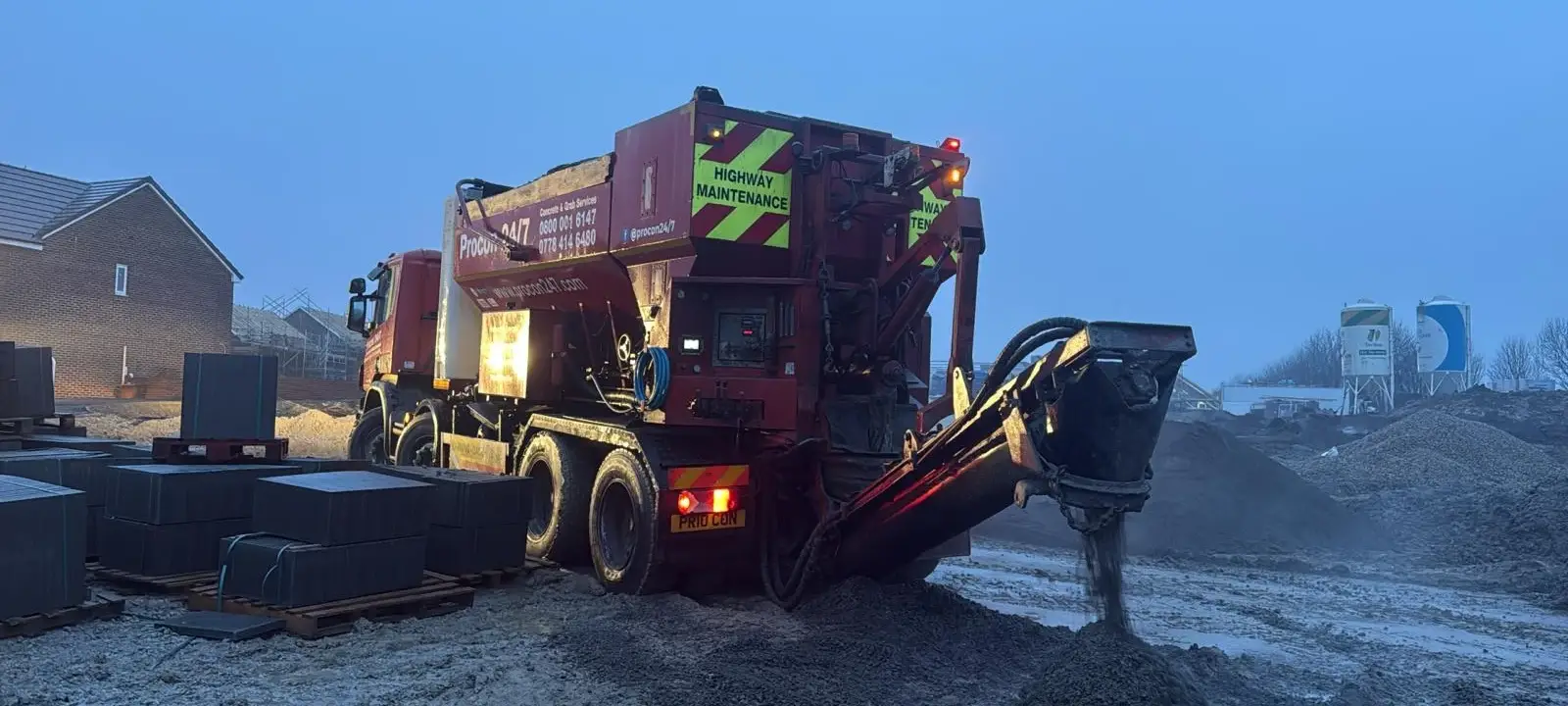
Lightweight, self-levelling foamed concrete for voids, trenches and insulation.
Trusted by contractors, councils & developers






Foamed concrete, also called foam concrete or CLSM, is a lightweight cement-based fill with a large volume of air deliberately mixed into it as a stable foam. It flows into a void, finds its own level and sets without anyone compacting it, which is why it is specified for trench reinstatement, redundant tanks and pipe runs, and for lightweight fill on ground that will not take the load of a granular alternative. We batch it on site to the density your specification calls for, metered by the cubic metre placed, with no full-load minimum.
Mixed on site to the figure on your specification, anywhere from 400 to 1600 kg/m³, rather than to whatever a plant produced that morning.
No vibration, no tamping, no compaction plant and nobody entering a confined space to compact fill.
Metered by the cubic metre actually placed, so a single small void is a normal booking rather than an awkward one.
650m³ across 50 loads reinstating 2km of utility trench under a Yorkshire Water framework, surfaced the next day.
Road foam self-compacts around replacement service pipework where a compacted granular fill cannot be tamped without risking the pipe. We reinstated 2km of trench on a live North Yorkshire carriageway under a Yorkshire Water framework this way.
Disused tanks, culverts, basements and abandoned pipe runs. Free-flowing fill finds the whole void without anyone entering a confined space to compact it.
Low-density mixes weigh far less than granular fill, which matters where the ground beneath will not take the additional load. Reducing the imposed load is often cheaper than improving the ground.
Behind abutments and retaining walls a lighter backfill exerts less lateral pressure on the structure it sits against, so the fill stops being part of the problem the wall has to solve.
The trapped air that lowers the density also lowers thermal conductivity, so low-density mixes are used as insulating layers in floor build-ups and beneath roof finishes.
Foamed concrete is priced per cubic metre placed, and the density you specify is the main driver.
Give us the void volume and the specified density and we will price it. For utilities and highways schemes, tell us the reinstatement window and send the scheme specification so we batch to it. Call 0800 001 6147.
Foamed concrete is made in two parts. A base slurry of cement, water and fine sand is batched first, then a stable pre-formed foam is generated separately and blended into that slurry. The volume of foam blended in is what sets the finished density, which is why foamed concrete is produced to a specified density rather than mixed to a fixed recipe. Because we batch on site rather than delivering a pre-mixed load, the density is set at your pour against your specification. If a void takes more than the estimate, we mix more rather than leaving you short, and you are billed for what went into the ground.
A foamed concrete base mix is cement, water, a foaming agent and fine sand, generally 5mm down. The absence of coarse aggregate is deliberate rather than a cost saving. With a high volume of air and water in the mix, stone would segregate and drop out of suspension, leaving a dense stony bottom and a weak foamed top instead of one consistent material. Keeping the aggregate fine holds the binder and filler in suspension around the foam while the cement hydrates, which is what produces a uniform fill through the full depth of the pour.
Foamed concrete carries a cement content well above a normal structural mix, commonly from around 350 kg/m³ upwards. That looks counterintuitive for a deliberately weak material, and there are two reasons for it. Air reduces the strength of concrete exponentially, and water reduces it linearly, and a foamed mix carries a great deal of both. The mix also runs wetter than a structural concrete because it has to stay fluid enough to pump and to blend with the foam without bursting the bubbles. Water-reducing plasticisers, which would normally solve that, do not sit well alongside foaming agents. The cement content is what buys back usable strength against all of that.
Density is the specification. Strength, weight, insulation value and yield all track it, so choosing the density is the real decision and everything else follows from it. Lower densities give the least load on weak ground and the best thermal performance, and give up strength to do it. Higher densities give more strength for trafficked reinstatement, at more weight and more material per cubic metre. If your specification names a density, that is the figure to give us. If it does not, tell us the application, the depth of fill and whether anything will be surfaced or trafficked over it, and we will tell you which band fits.
On trench and carriageway reinstatement the requirement is usually set by the highway authority or by the client framework rather than by us, covering the density, the fill depth and how quickly the surface course follows. Send us that specification with the enquiry and we batch to it. Where a scheme calls for density checks or cube samples at the point of pour, say so at the order stage so it is planned in rather than raised on the day. Our North Yorkshire scheme ran under a Yorkshire Water framework across 2km of live carriageway, and the fill was surfaced the following day.
We run foamed concrete out of three depots. If your site is inside these postcode areas, ring us and we will tell you which depot is closest and roughly how long it takes to reach you.
650m³ of premium foamed concrete across 50 loads, reinstating 2km of utility trench on a major carriageway and its trunk roads under a Yorkshire Water framework.
Read the case studyThe things customers ask us most about foamed concrete.
CLSM stands for controlled low strength material, a self-compacting flowable fill designed to be deliberately weak so it can be re-excavated later. Foamed concrete is the most common form of CLSM in the UK. It is specified for trench reinstatement, void filling and backfill where a compacted granular fill would be impractical, and where a full-strength concrete would make future excavation difficult.
We batch across roughly 400 to 1600 kg/m³, against about 2400 for a standard concrete. Lower densities give more insulation and less imposed load, higher densities give more strength. Because we batch on site, we mix to the density your specification calls for rather than to whatever a plant has produced that day.
Typically somewhere around 1 to 10 N/mm² in compression depending on the density specified, against roughly 25 to 40 for a structural concrete. Strength tracks density closely, so a low-density mix specified for insulation or load reduction sits at the bottom of that range and a denser mix for a trafficked reinstatement nearer the top. It is not a structural material at any density in that band.
There is no single ratio, which is the practical answer. Foamed concrete is batched to a target density by adjusting how much pre-formed foam is blended into a cement, water and fine sand base slurry, so the design is set by the density and strength you need rather than by a fixed proportion like a 1:2:4 concrete. Give us the specified density and we will design the mix to hit it.
No. It is self-compacting and flows to fill the void, which is the main reason it is specified for trench reinstatement around service pipework and for filling redundant tanks and culverts. It removes both the compaction plant and the need for anyone to enter a confined space to compact fill.
Yes, and that is deliberate. As a CLSM it is specified to be weak enough to re-excavate with normal plant rather than needing breakers. On utility routes that matters, because whoever opens that trench next should not be fighting a full-strength slab to reach the services underneath.
Not directly. It is a fill material with poor abrasion resistance, so on a carriageway it is surfaced over. On the North Yorkshire utility scheme we reinstated, the fill was surfaced the next day. The specified density and the surfacing detail determine the turnaround, so confirm both with the scheme engineer.
Yes, and the lower the density the better it performs. The trapped air that reduces the weight also reduces thermal conductivity, so low-density foamed concrete is used as an insulating layer in floor build-ups and beneath roof finishes. The trade-off is explicit, because the mix that insulates best is also the weakest.
Road foam is foamed concrete used specifically for trench and carriageway reinstatement. It is a self-compacting fill that flows around replacement pipework and sets ready to be surfaced, which is why it is common on utility schemes working under highway authority reinstatement windows.
Yes. There is no full-load minimum, so a single redundant tank or a short run of trench is a normal booking. The mixer batches what the void takes and meters it, which is exactly the case where ordering a full pre-mixed load makes no sense.
Yorkshire and the North West from our depots, covering utilities and highways schemes as well as one-off void filling. Tell us the site postcode with the enquiry and we will confirm coverage and the delivery window.
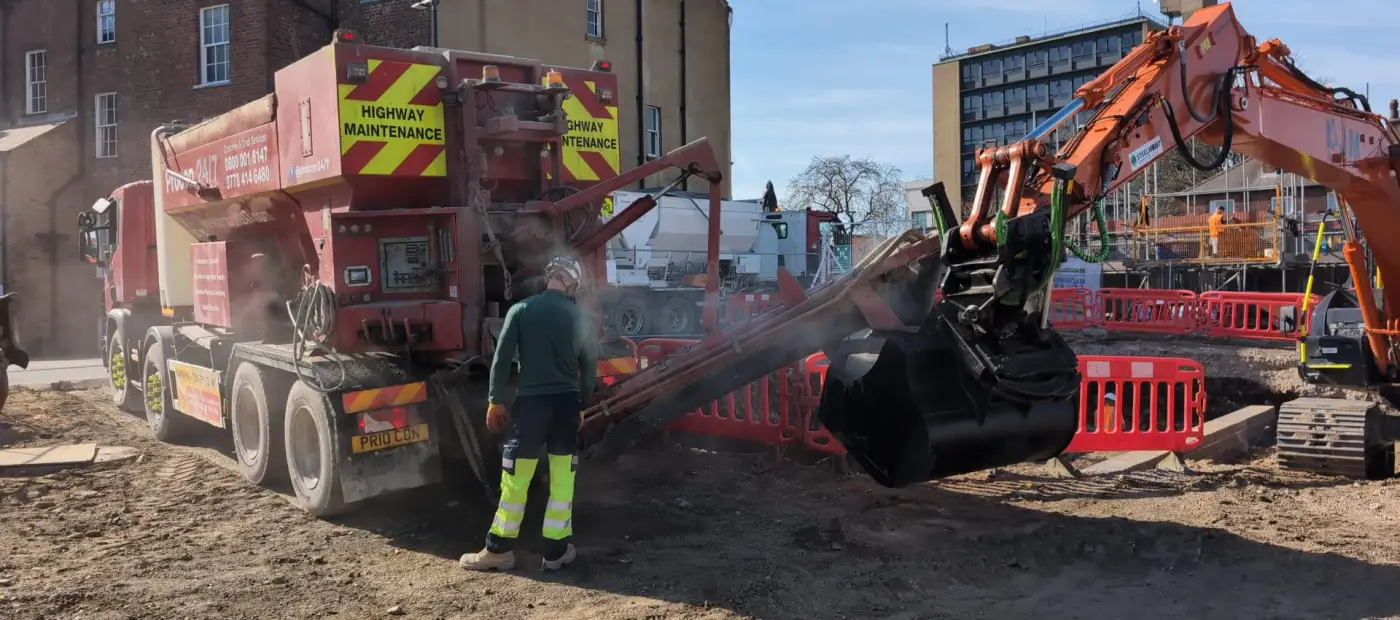
Same-day where we can, fresh every pour, across Yorkshire and the North West.
Leeds · Bradford · York · Sheffield · Wakefield · Manchester · Liverpool · Preston · Huddersfield · Halifax · & every site in between