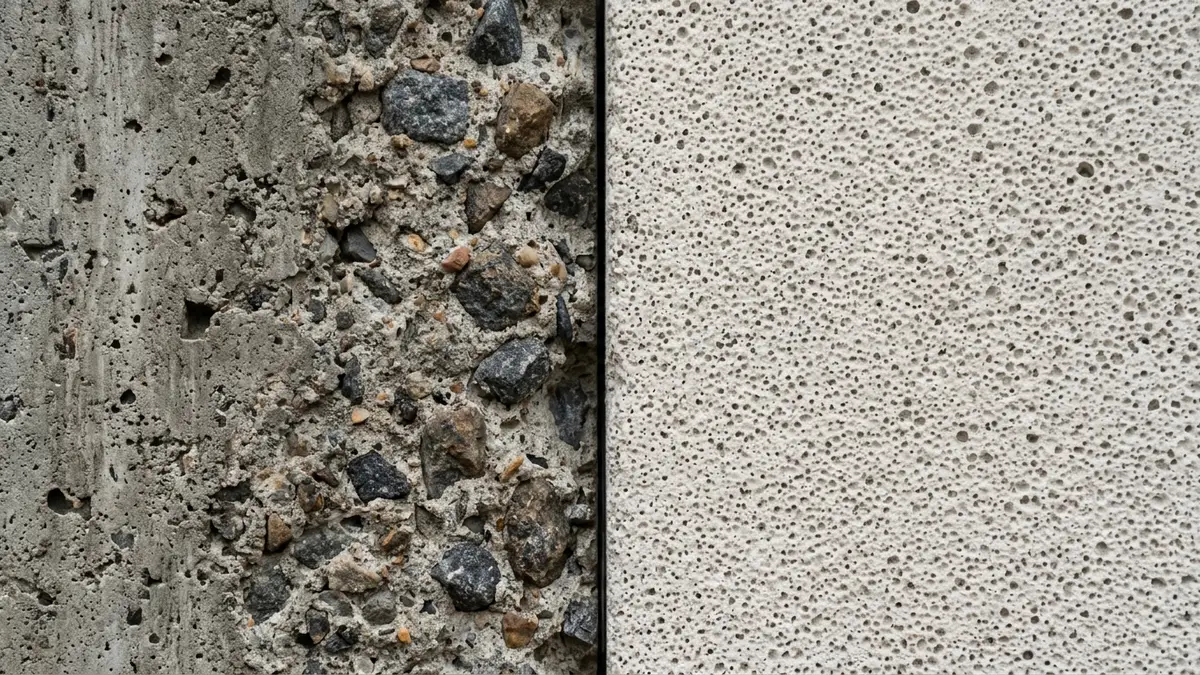
Normal concrete and foamed concrete share a binder and almost nothing else. One is engineered to carry load, the other to fill space without being compacted, and nearly every practical difference between them follows from a single swap in the ingredients.
The One Difference Everything Else Comes From
Normal concrete is cement, sand, stone aggregate and water. The coarse stone is the structural skeleton, and it is most of why the material is both strong and heavy.
Foamed concrete takes the stone out and puts air in, held as a stable pre-formed foam. So it is cement, water, that foam, and usually a fine sand, with the lowest densities often dropping the sand too.
Remove the skeleton and the material stops being structural. Replace it with air and the material becomes light, fluid and insulating. Every row in the table below is downstream of that one change.
Side by Side
| Property | Normal concrete | Foamed concrete |
|---|---|---|
| Coarse stone aggregate | Yes | No |
| Foam | No | Yes, 20% air upwards |
| Density | Around 2300 to 2400 kg/m3 | Around 400 to 1600 kg/m3 |
| Compressive strength | Roughly 25 to 40 MPa | Roughly 1 to 10 MPa |
| Water to cement ratio | Around 0.4 | Around 0.6 |
| Fluidity | Low slump, needs placing | Free flowing, self levelling |
| Compaction | Required, vibrated or tamped | None, self compacting |
| Thermal conductivity | Around 0.9 to 1.4 W/mK | Around 0.1 to 0.66 W/mK |
| Re-excavation | Needs breaking out | Designed to be dug out |
| Takes reinforcement | Yes | No, treat as unreinforced |
| Main role | Carrying load | Filling space, reducing load |
Density in particular is a specified figure rather than a fixed property of the material. The figures above are the bands we batch and work to.
Why Foamed Concrete Needs More Water
This is the difference that gets skipped, and it explains a lot of the material's behaviour.
A structural mix wants the water to cement ratio as low as workability allows, because excess water means lower strength. Around 0.4 is typical. Foamed concrete deliberately runs wetter, nearer 0.6, and not because anyone is being careless.
The reason is the foam itself. If the base slurry is too stiff, the shear of mixing bursts the bubbles, the entrained air escapes, and the material collapses to a density well above the one it was batched to. The extra water keeps the slurry fluid enough for the bubble structure to survive intact. It also contributes to the slower set, since there is more water to lose and far less solid material conducting the reaction.
So the higher water content is not a compromise on quality, it is what makes the specified density achievable at all.
Weight, and Why It Decides Jobs
The density gap is the single most useful number here. At roughly 2300 to 2400 kg per cubic metre, normal concrete adds serious load to whatever is beneath it. Foamed concrete at 400 to 1600 kg per cubic metre can weigh less than a quarter of that at the light end.
That matters in three recurring situations: filling a void over ground that will not take more load, backfilling behind a retaining structure or bridge abutment where lateral pressure is the constraint, and adding a layer to an existing structure that was never designed for the extra weight. In all three, strength is not the question being asked. Weight is.
Placement: Compacted Versus Self Compacting
Normal concrete has to be placed and compacted, vibrated or tamped to drive out entrapped air and get it around reinforcement. Skip that and you get honeycombing and voids.
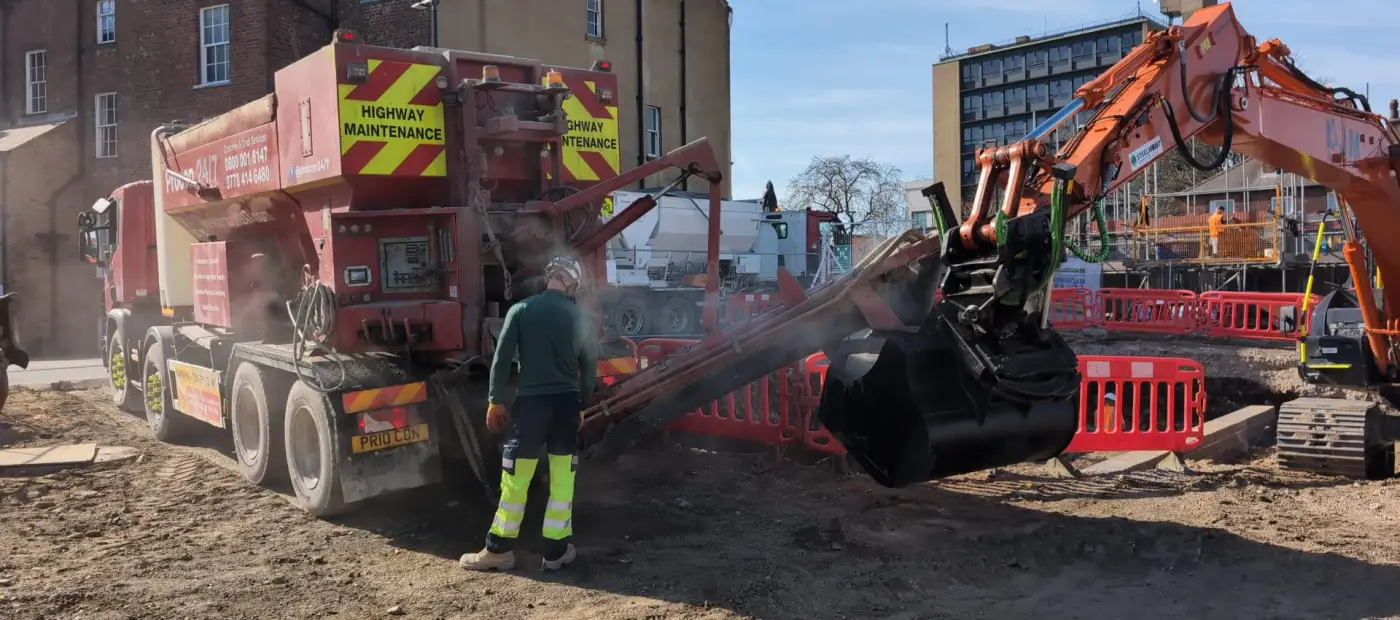
Foamed concrete is the inverse. The air is the point, so it is never vibrated. It flows into the space, finds its own level and supports itself. That is what lets it be used around live service pipework that compaction could damage, and inside voids nobody can safely enter to compact anything.
It is also why it pumps well over distance and height, which frequently decides the job where access is poor.
When Each One Is the Wrong Choice
Do not use foamed concrete for: foundations, load-bearing slabs, driveways, anything taking point loads, any trafficked wearing surface, or anything relying on reinforcement. It is not a cheaper lightweight substitute for a structural mix, and using it as one produces a failure rather than a saving.
Do not use normal concrete for: filling a void you cannot get a compactor into, backfilling around fragile service pipework, any application where the load on the ground below is the binding constraint, an insulation layer, or a trench that somebody will need to re-excavate. A full-strength backfill in a utility trench is a problem handed to whoever opens it next.
The Option People Miss
A lot of the time foamed concrete gets considered for the wrong reason: someone wants a material that flows into an awkward space without compaction, and assumes lightweight is the way to get it.
If the element is structural, the material you actually want is self-compacting concrete. It flows and self-levels like foamed concrete, but keeps the coarse aggregate and full structural strength. Foamed concrete gives up strength to gain flow. Self-compacting concrete gets the flow without that trade, which makes it the right answer whenever load is involved.
Choosing Between Them
Work backwards from what the material has to do:
- Carries load? Normal structural concrete, and specify the grade.
- Carries load and has to flow into congested reinforcement? Self-compacting concrete.
- Fills a void, reinstates a trench, reduces load or insulates? Foamed concrete, and the density becomes the specification.
For more on the material itself, see what foamed concrete is and how it is made, the uses and benefits in detail, and the honest disadvantages. If you know the grade you need on the structural side, our concrete grades and strengths guide covers that, and the concrete calculator will convert your dimensions into a volume.
We supply both. Foamed concrete batched on site to your specified density, and ready-mix and volumetric concrete across the grades. Tell us what the material has to do on 0800 001 6147 and we will tell you which one you want, including when the answer is the cheaper of the two.