Foamed concrete is a cement slurry with air deliberately introduced as a stable foam, giving a lightweight material that flows into place and needs no compaction. It is genuinely excellent at a narrow set of jobs and genuinely unsuitable for most others, so the useful thing is knowing which is which.
This guide is about the limits. For the material itself see what foamed concrete is and how it is made, for the applications in full see the uses and benefits guide, and for the direct comparison see foamed concrete versus normal concrete.
What Foamed Concrete Actually Is
A pre-formed foam is mixed into a cement slurry, entraining a large volume of air, typically anywhere from 20 to 80 percent depending on the specification. There is no coarse aggregate, which is why it flows the way it does.
The result has a dry density of roughly 400 to 1,600 kg per cubic metre, against about 2,400 for standard concrete. Density is specified to suit the application, and it drives everything else: lower density is lighter, more insulating and weaker, higher density is stronger with less weight saving.
You will also see it called lightweight cellular concrete, LCC, aircrete, or road foam in utility reinstatement work.
What It Is Used For
Void filling. Abandoned pipes, disused tanks, culverts, mineshafts and cellars. Because it flows and self-compacts, it reaches the far corners of a void nobody can get plant into. Nothing granular does that job as reliably.
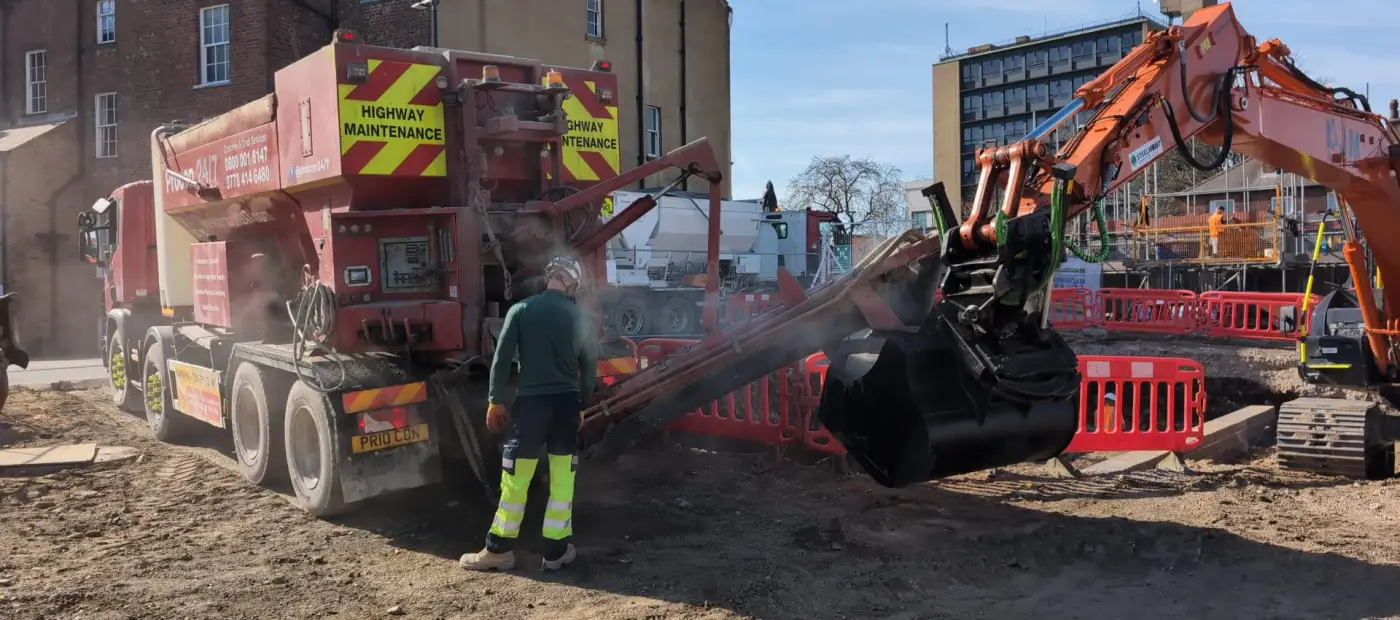
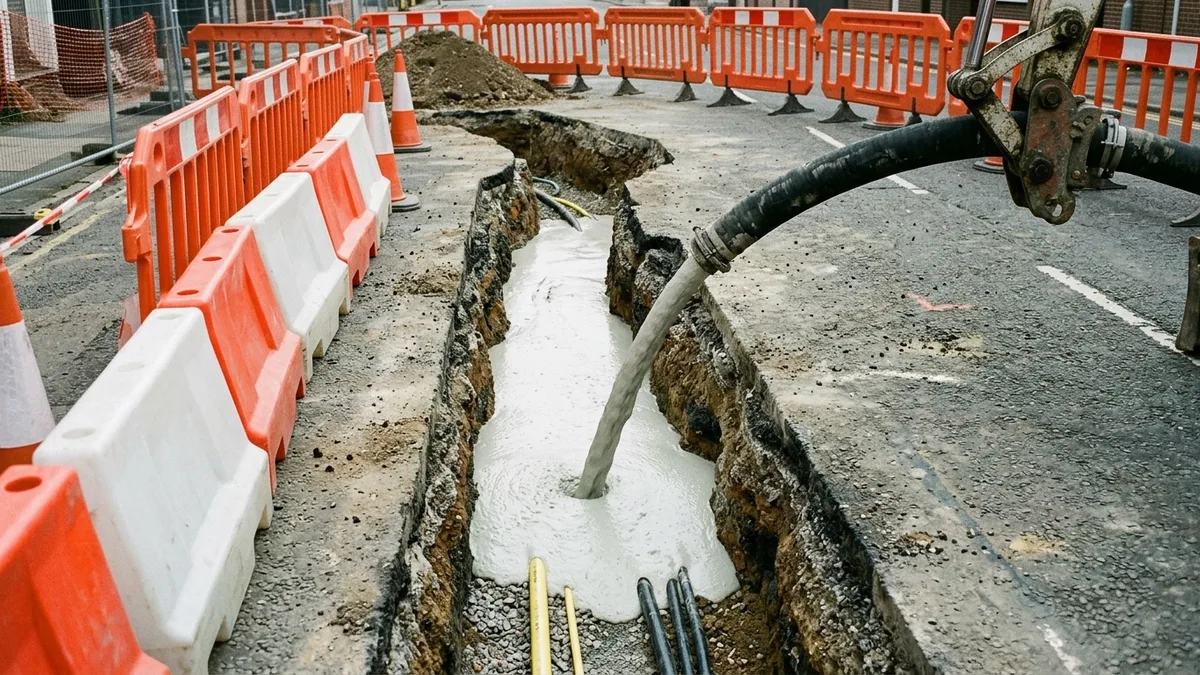
Trench reinstatement. The road foam application. A utility trench filled with foamed concrete is reinstated in one operation with no compaction in layers, and the road reopens faster. Our North Yorkshire reinstatement case study covers 650 cubic metres across 2km of live carriageway trench.
Lightweight fill and ground stabilisation. Where the ground beneath cannot carry the weight of conventional fill, a lighter material reduces the imposed load. Embankments over soft ground and fill behind retaining structures both use it for this reason, because reducing the load is often cheaper than strengthening the ground.
Insulating layers. The trapped air gives useful thermal performance, so it appears as an insulating screed or roof layer, though a purpose-made insulation product usually beats it where insulation is the only requirement.
The Disadvantages, Honestly
This is the part most supplier pages skip, and it is the part that stops it being used wrongly.
- Low compressive strength. Typically 1 to 10 MPa, against 25 to 40 for structural grades. It is not a structural material and no dosage adjustment makes it one.
- Not suitable for point loads. Distributed load is one thing; a concentrated load such as a column base or jack pad is another, and foamed concrete is the wrong material for it.
- Higher drying shrinkage. The high paste and low aggregate content mean more shrinkage than a conventional mix, which matters where movement would be a problem.
- Water absorption. The cellular structure takes up water readily unless specified against it. Saturated foamed concrete is heavier and weaker, and freeze-thaw becomes a genuine risk in exposed positions.
- Poor abrasion resistance. It cannot serve as a wearing surface. In reinstatement it is always capped with a proper surface course above.
- Reinforcement is not straightforward. The low strength and alkalinity profile make it a poor host for steel, so it is not used as reinforced concrete.
- It needs specialist plant. Producing stable foam and mixing it consistently is not something a standard drum wagon does, which is why fewer suppliers offer it.
How Long Does It Last?
In the buried applications it is designed for, indefinitely. It is cement-based, so it does not rot or decompose, and trench reinstatement or void fill placed today should remain serviceable for the life of the asset above it.
Its durability limits are about exposure rather than age. Left exposed to traffic, running water or freeze-thaw without protection it will deteriorate, which is why it is specified as a buried or capped material. Used as intended, service life is not the constraint.
Foamed Concrete or Standard Concrete?
The question answers itself once you ask what the material has to do:
- Carrying load? Standard concrete. See our grades guide.
- Filling a space, reducing weight, or reaching somewhere plant cannot? Foamed concrete.
- Needs reinforcement? Standard concrete, every time.
- Needs to be walked or driven on directly? Standard concrete, or foamed concrete with a wearing surface over it.
The one misuse worth naming: choosing foamed concrete for a slab or foundation because the per cubic metre rate looks lower. That is buying the wrong material on price, and the failure is expensive because it means breaking out and starting again. If flowability into congested reinforcement is the actual problem, self-compacting concrete is the material you want, not foamed concrete.
Procon 24/7 supplies foamed concrete across Yorkshire and the North West, batched on site to the specified density. Tell us the void volume and the application on 0800 001 6147 and we will specify the density rather than leaving you to guess it.