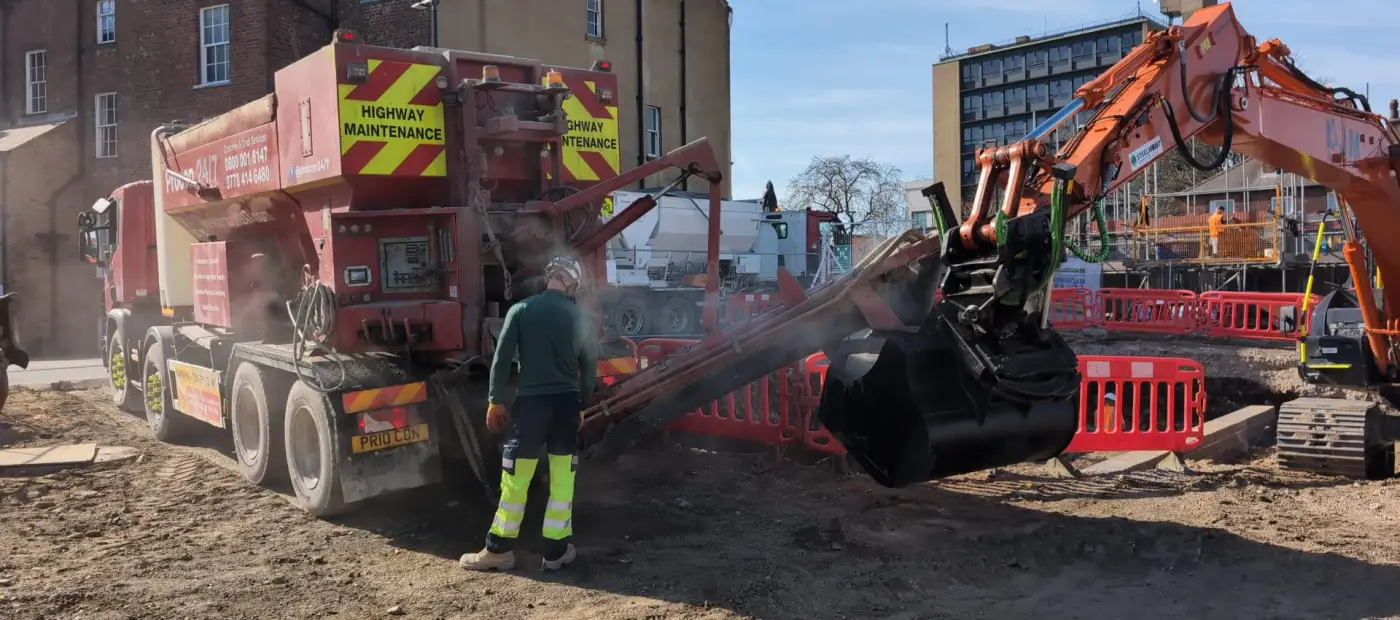
Foamed concrete is a cement-based material with a large volume of air deliberately trapped inside it as a stable foam. That air replaces the coarse stone aggregate that gives normal concrete its strength and weight, which is why foamed concrete pours like a thick liquid, fills a void without being compacted, and weighs a fraction of what a standard mix does.
It is a genuine concrete, not a filler or a foam product. It just does a completely different job from the concrete most people picture.
What Foamed Concrete Is Made Of
The ingredient list is short, and one absence defines the material:
- Cement. The binder, as in any concrete.
- Water. Generally at a higher ratio than a structural mix, which is part of why it flows.
- Pre-formed foam. A surfactant-based foam generated separately and blended in. This is the defining ingredient.
- Fine sand or a fine filler such as fly ash in many mixes, though some low-density mixes are cement and foam only.
- No coarse aggregate. No gravel, no 20mm stone. Air occupies that space instead.
Definitions vary slightly by source, but the common threshold is that a material needs at least 20 percent air by volume to count as foamed concrete. In practice many mixes run far higher, up to around 80 percent air for the lightest grades.
How Foamed Concrete Is Made
The standard UK production route is the pre-formed foam method, and it works in two stages.
First a base slurry is batched from cement, water and any fine filler. Separately, a foam generator produces a stable foam from a foaming agent and water, with a consistency close to shaving foam. That foam is then blended into the base slurry in a measured quantity.
The volume of foam added is what determines the final density, and that is the important part: foamed concrete is produced to a specified density rather than mixed to a fixed recipe. Because we batch on site, the density can be dialled to what the specification calls for on the day rather than being fixed when a load left a plant.
The alternative route, mixed foaming, adds a foaming agent into the mix itself and generates the bubbles through agitation. It is less common in UK site work because it gives less precise control over the finished density.
Density and Strength: the Two Numbers That Matter
Almost every practical question about foamed concrete resolves to density, because strength, weight, insulation value and cost all track it.
Foamed concrete spans roughly 400 to 1600 kg per cubic metre. Normal concrete sits at about 2300 to 2400 kg per cubic metre, so even a dense foamed mix is meaningfully lighter, and a low-density mix is a different order of thing entirely.
Compressive strength follows, generally landing somewhere around 1 to 10 MPa against roughly 25 to 40 MPa for structural concrete. That sounds like a weakness and is usually the point. For trench reinstatement the material is meant to be weak enough to dig out again later without breaking out a full-strength slab.
Choosing the density is therefore the real specification decision:
- Lower densities give more insulation value and the least load on ground that will not take much, at the cost of strength.
- Higher densities give more strength for reinstatement and trafficked areas, at more weight and more material per cubic metre.
If your specification names a density, that is the number to give us. If it does not, the application and any trafficking requirement will point at the right band.
How Long Does Foam Concrete Take to Set?
More slowly than a dense concrete, because there is more water and far more air in it. The honest answer is that it depends on the density and the mix, so the trafficking time should come from the supplier for your specified density rather than from a rule of thumb.
What the schedule looks like in practice is more useful than a number. On a live carriageway scheme in North Yorkshire we placed 650m3 across 50 loads to reinstate 2km of utility trench, and the fill was surfaced the following day. Being able to backfill and resurface inside that window is one of the main reasons foamed concrete gets specified on roads at all, because the alternative is a compacted granular fill placed and tamped in layers.
Like any cementitious material, it keeps gaining strength for weeks after it stops being walkable, so early trafficking and final strength are two separate questions.
The Other Names It Hides Behind
Specifications rarely all use the same word, which causes a lot of confusion when people are pricing the same material three different ways:
- Foam concrete / foamcrete. The same thing, shortened.
- Cellular concrete or lightweight cellular concrete (LCC). Descriptive of the closed-cell structure.
- CLSM (controlled low strength material). A category of deliberately weak flowable fill. Foamed concrete is the most common UK form of it, so a CLSM spec is usually met with foamed concrete.
- Flowable fill or road foam. Application-led names, generally used around trench and highways reinstatement.
- Aircrete. Worth separating out. This usually refers to autoclaved aerated concrete blocks, which are factory-made and steam-cured rather than poured on site. Related idea, different product.
One more that is not a synonym at all: expanding foam. That is a polyurethane product with no cement in it. It is not concrete, it does not cure like concrete, and it should not be substituted for it.
Where It Goes From Here
Knowing what the material is only gets you halfway. The two questions that follow are what it is actually good for and whether it can stand in for a normal mix, and both have proper answers:
- Our guide to the uses and benefits of foam concrete covers void fill, trench reinstatement, insulation layers and why self-compaction changes the economics of a job.
- Our foamed concrete versus normal concrete comparison sets the two side by side on composition, weight, strength and placement, and is direct about where foamed concrete is the wrong answer.
- Our honest look at the disadvantages covers the limits worth knowing before specifying it.
We batch foamed concrete on site to the density your specification calls for, metered by the cubic metre placed, with no full-load minimum. Tell us the void volume and the specified density on 0800 001 6147 and we will price it, and if there is a reinstatement window to hit, tell us that too.