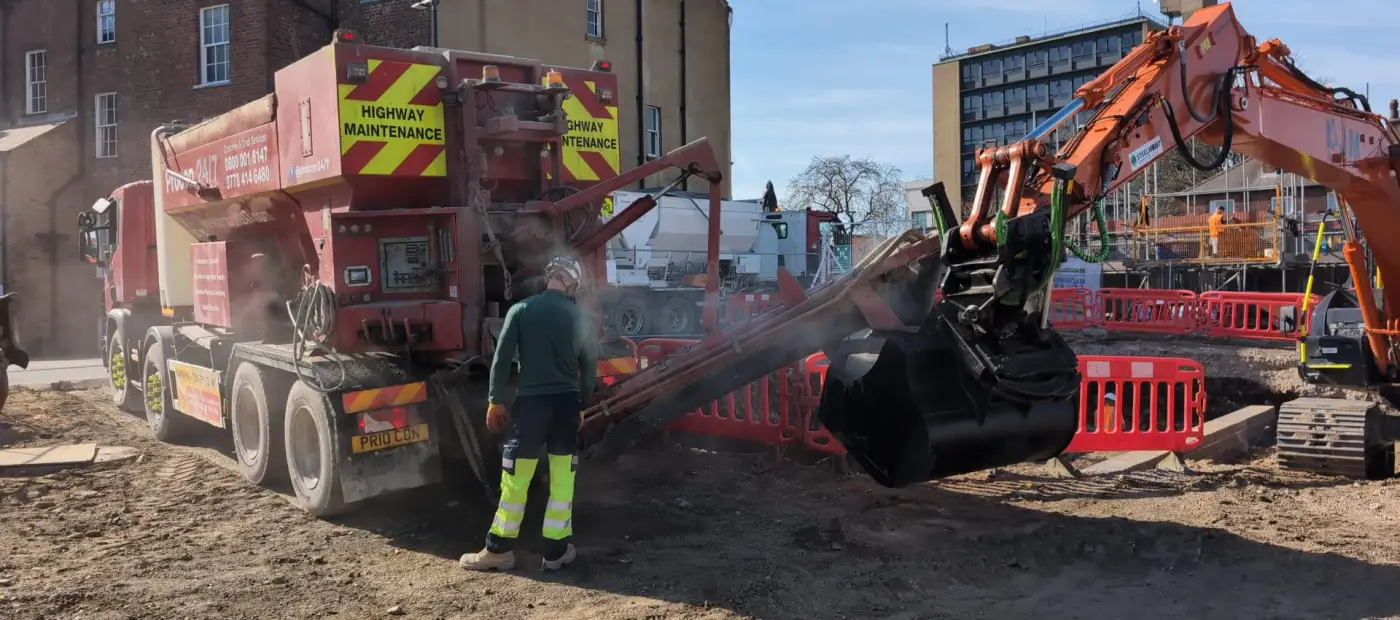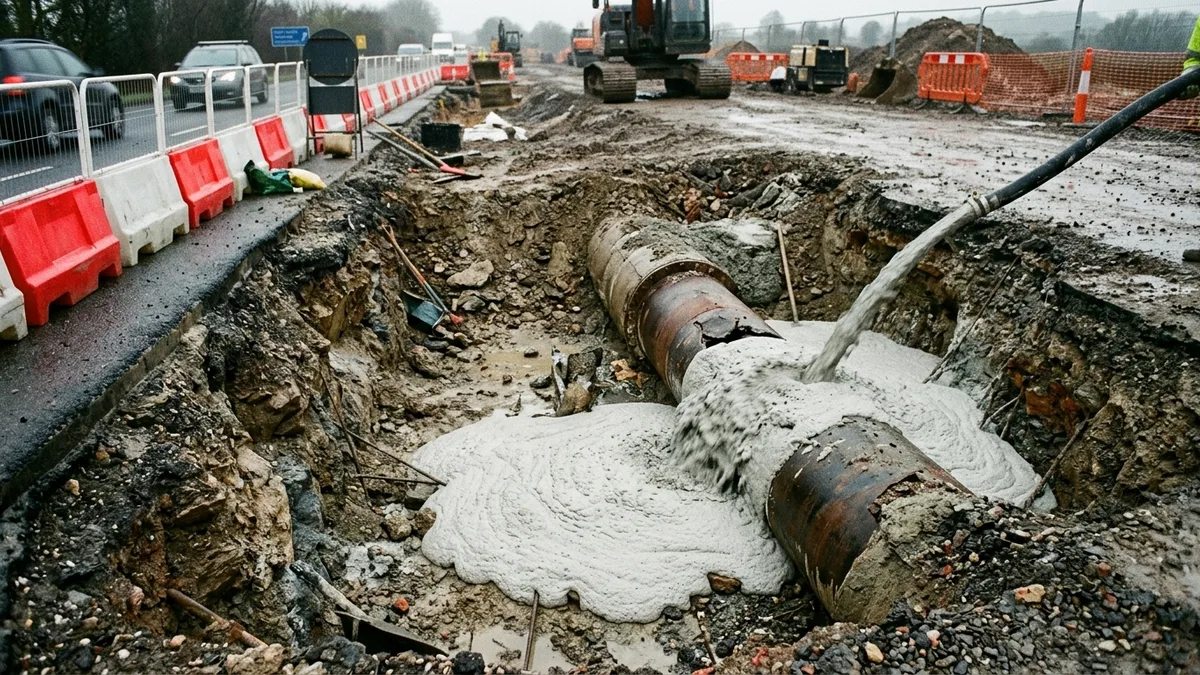
Foam concrete is not a cheaper substitute for a structural mix, and specifying it as one is the most common mistake made with it. It earns its place on a job for a different reason: it flows into a space, fills it completely, and sets without anyone compacting it.
Almost every application below follows from that one property.
What Foam Concrete Is Used For
Utility trench and carriageway reinstatement
The biggest UK use. When a trench is opened in a road to replace services, the backfill has to go in around live pipework and be ready to take a surface quickly. A granular fill has to be compacted in layers, and compacting tightly around a replacement service pipe risks damaging the thing that was just installed.
Foam concrete self-compacts around the pipework instead. On a live carriageway scheme in North Yorkshire, under a Yorkshire Water framework, we placed 650m3 across 50 loads to reinstate 2km of utility trench, and the fill was surfaced the following day. On a live road, that turnaround is usually the entire argument.
Filling redundant voids
Disused tanks, culverts, basements, old cellars and abandoned pipe runs all need filling, and all share the same problem: nobody can get inside to compact a fill, and often nobody should. Free-flowing material finds the whole void, including the parts that are not visible from the access point, with no confined space entry required to place it.
Reducing load on weak ground
Where the ground below will not take additional load, a low-density foam concrete can weigh a third or less of what a granular fill weighs. Filling a void with something light rather than something heavy can be the difference between a workable design and a ground improvement scheme.
The same logic applies behind bridge abutments and retaining structures, where a lighter backfill exerts less lateral pressure on the structure it sits against.
Insulation layers
The trapped air that lowers the density also lowers thermal conductivity, so low-density foam concrete works as an insulating layer in floor build-ups and beneath roof finishes. The trade-off is explicit: the mix that insulates best is also the weakest, so the density gets chosen against the load the layer actually has to carry.
Capping and levelling poor ground
As a capping layer over soft or variable ground it provides a level, self-supporting platform without the compaction passes a granular capping needs, which matters where the ground is too soft to compact against in the first place.
The Benefits, and What Each One Actually Buys You
- It self-compacts. No vibration, no tamping, no plate compactor, no compaction plant on site and no labour standing behind it. This is the headline benefit and most of the others follow from it.
- It fills the whole void. Because it flows, it reaches undercuts, corners and cavities that a compactor physically cannot, so there are no voids left behind the fill.
- It is light. Roughly 400 to 1600 kg per cubic metre against about 2300 to 2400 for normal concrete, which is what makes it viable on ground that will not take load.
- It pumps. Being a free-flowing slurry, it can be pumped over distance and up height, so the mixer can sit somewhere sensible and the material still reaches an awkward void.
- It can be dug out again. As CLSM it is specified to be weak enough to re-excavate with normal plant, which protects whoever opens that trench next.
- It does not settle. It sets as a solid mass rather than depending on compaction for density, so it avoids the delayed settlement that shows up as a depression in a road surface months after a poorly compacted backfill.
- It insulates. More so at lower densities, which is what makes the insulation-layer applications possible at all.
- It is fast. Placed in one operation rather than laid and compacted in layers, which on reinstatement work is usually where the real money is saved.
Is It Cheaper? Compare the Right Thing
Per cubic metre, foam concrete is generally not cheaper than a granular fill, and judging it on that number alone gets the decision wrong.
The comparison that matters is the placed cost. Against a compacted fill you are removing the compaction plant, the labour to operate it, the layered placement sequence and a meaningful chunk of programme. On highways and utilities work the programme saving from backfilling and surfacing quickly usually dominates the material difference outright, which is why the material keeps getting specified despite the higher rate per cubic metre.
Density is the other cost lever. Lower densities use less material per cubic metre placed, so they often cover more ground per pound, but they also give up strength. That trade-off is a specification decision rather than a way to save money.
Where Foam Concrete Is the Wrong Answer
Being straight about this is more useful than another benefit:
- Anything structural. Foundations, slabs carrying real load, anything relying on compressive strength. Foam concrete sits around 1 to 10 MPa against roughly 25 to 40 MPa for a structural mix.
- Point loads. The cellular structure does not handle concentrated loads the way dense concrete does.
- Trafficked wearing surfaces. Poor abrasion resistance, so it goes under a surface rather than being one.
- Anything relying on reinforcement. It is not a suitable host for structural reinforcement.
If flowability was the reason foam concrete looked attractive but the job genuinely needs strength, the material you actually want is a self-compacting structural mix, not a foamed one. Our foamed concrete versus normal concrete guide sets that decision out properly, and the disadvantages guide covers the limits in more depth.
New to the material? Start with what foamed concrete is and what it is made of.
We batch foamed concrete on site to your specified density, metered by the cubic metre placed with no full-load minimum, and the North Yorkshire utility reinstatement is written up in full. Give us the void volume and the density on 0800 001 6147, and tell us the reinstatement window if there is one.