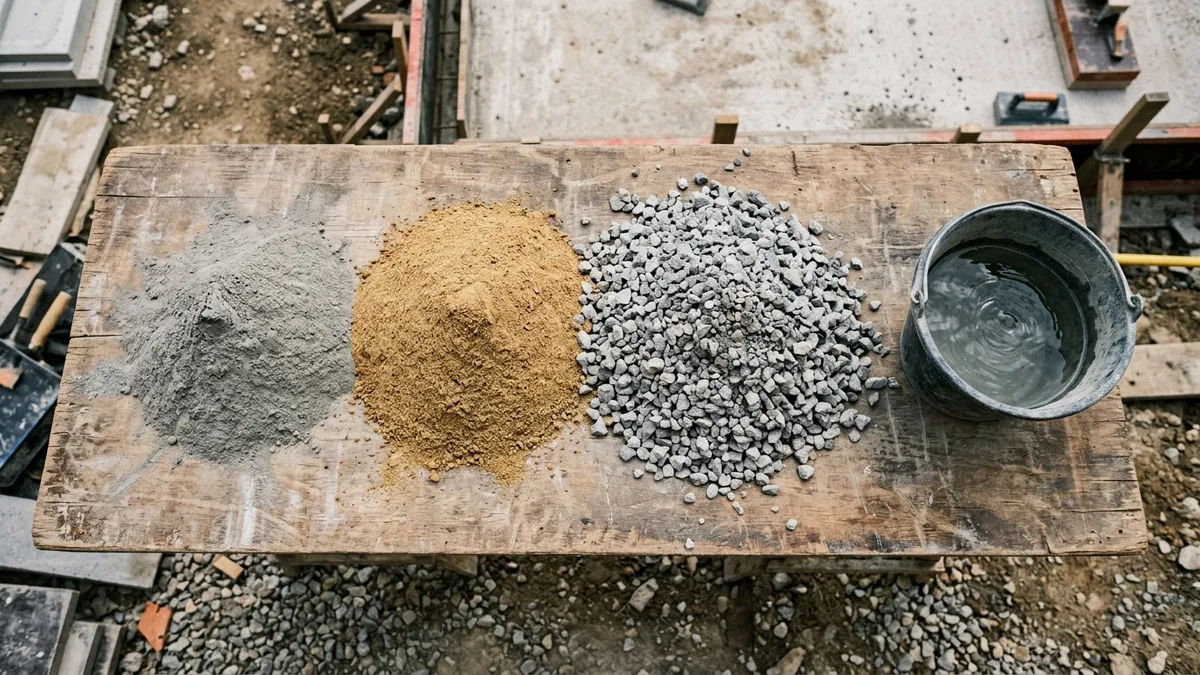
Quick answer: the standard concrete mix ratio is 1:2:4 (cement:sand:aggregate) by volume for general-purpose work such as paths and shed bases, roughly C20 strength. Structural jobs like driveways and foundations use a richer 1:1.5:3, and non-structural mass fill uses a leaner 1:3:6.
Concrete mix ratio is written as three numbers, cement to sand to aggregate, and it describes the proportion of each ingredient by volume. Get it right and you get concrete that hits the strength the job needs. Get it wrong, and the failure usually shows up months later as cracking, dusting or a surface that breaks up under load.
What Are the Standard Concrete Mix Ratios?
Three ratios cover the large majority of UK work. The pattern is straightforward: the more cement relative to the aggregate, the stronger and more expensive the concrete.
- 1:3:6 (cement:sand:aggregate). A lean mix for non-structural work, roughly C10 to C15. Used for blinding, mass fill, backfilling and kerb haunching where the concrete supports nothing.
- 1:2:4. The general-purpose standard, roughly C20. This is the default for paths, shed bases, patio bases and non-structural domestic slabs, and is the ratio most people mean when they ask for the concrete mix ratio.
- 1:1.5:3. A richer structural mix, roughly C25 to C30. Used for driveways, foundations, structural slabs and anything carrying real load.
One important caveat: these ratios give you approximate grades, not specified ones. A specified C25 means concrete independently tested to reach 25 MPa at 28 days, which requires designed proportions and documented batching. If your building control officer or structural engineer has asked for C25, a bucket-batched 1:1.5:3 mix is not evidence of it. Our guide to concrete grades and strengths covers the difference in full.
What Is the 4-2-1 Rule for Concrete?
The 4-2-1 rule is a way of remembering a general-purpose mix: four parts coarse aggregate, two parts sand, one part cement, by volume. Written in the usual cement-first order that is 1:2:4, the same standard general-purpose ratio described above, producing roughly C20 concrete.
It is a memory aid rather than a specification. It says nothing about the water content, which has a larger effect on final strength than the aggregate proportions do, and nothing about the aggregate size or the exposure conditions. Used for a path or a shed base it is perfectly sound. Used as a substitute for a designed mix on structural work it is not, for the same reason set out above: an approximate ratio is not a certified grade.
Which Mix Ratio Do You Need for Your Job?
Matching the ratio to the application is mostly about how much load the concrete carries and what the weather will do to it:
- Garden paths and patio bases: 1:2:4. Foot traffic only, so a general-purpose mix is sufficient.
- Shed and garden building bases: 1:2:4. A properly compacted sub-base matters more here than a richer mix.
- Driveways: 1:1.5:3. Repeated vehicle loading and freeze-thaw exposure both argue for the stronger mix, and air entrainment is worth specifying for UK winters.
- Foundations and footings: 1:1.5:3 as a minimum, and follow the engineer's specification where one exists. See our guide to concrete for footings and foundations.
- Fence post setting: 1:2:4, or a proprietary postcrete for single posts where mixing a batch is not worth the effort.
- Blinding and mass fill: 1:3:6. The concrete is providing bulk and a level working surface, not strength.
Why Does the Water-Cement Ratio Matter More Than the Mix Ratio?
This is the part that gets missed. The water-cement ratio, the weight of water divided by the weight of cement, has a larger influence on final strength than the cement-sand-aggregate proportions do.
Cement needs only about 0.25 to 0.30 of its own weight in water to hydrate fully. Everything beyond that is there purely to make the mix workable, and once the concrete hardens that surplus water leaves behind capillary voids. Those voids are what reduce strength and let water in later. A target of around 0.5 balances workability against strength for most site work.
In practice, that means a 25kg bag of cement takes roughly 12.5 litres of water. The temptation on site is always to add another splash to make the mix easier to move, and that splash is exactly what costs you the strength you were mixing for. If the mix is too stiff to place, the correct answer is a plasticiser rather than more water. Our guide to admixture dosage covers the rates.
How Do You Batch a Mix Ratio Accurately on Site?
Use one container for everything. A ratio measured with a bucket for the cement and a shovel for the aggregate is not a ratio, because shovel loads vary with the material and the person wielding it. One bucket of cement, two of sand and four of aggregate gives you a genuine 1:2:4.
Watch the sand in particular. Damp sand bulks up significantly, by as much as 20 to 30 percent, so a bucket of damp sand contains noticeably less actual sand than a bucket of dry sand. That single effect quietly makes a lot of site-batched mixes leaner than intended.
Mix the sand and aggregate first, then add cement and turn until the colour is completely uniform with no streaks. Add water gradually, holding the last of it back until you can judge the consistency. The mix should hold a ridge when you draw a shovel through it. Water sitting on the surface means you have gone too far, and there is no way to take it back out.
When Should You Stop Worrying About Ratios and Order Concrete?
Related reading: poor man's concrete and the fairy liquid myth, and how many bags make a cubic metre.
Site batching stops making sense somewhere around a quarter of a cubic metre. Beyond that you are mixing for hours, the batch-to-batch consistency drifts, and cold joints form between loads because early batches are setting while you mix the later ones.
Delivered concrete removes the ratio question entirely, because the proportions are designed and batched to the grade rather than approximated with a bucket. Volumetric concrete is mixed on site to the specified grade and metered by the cubic metre, so there is no minimum load and no waste. Our guide on how concrete is mixed in 2025 compares the methods, and the bagged concrete guide covers where bags still make sense.
Use our concrete calculator to work out the volume first. If it comes out above a quarter of a cubic metre, ordering is almost always cheaper than bagging it once you count the bags, the mixer hire and the day.