Most pages on this subject are written to sell one surface. This one sets out the genuine downsides of a concrete driveway alongside the advantages, because the failures are nearly all avoidable at specification stage and worth knowing about before you commit.
The Downsides, Stated Plainly
It can crack. Concrete shrinks as it cures. That is not a defect, it is the material, and it is managed with control joints that decide where movement happens. Laid without joints, on a poor sub-base, or at the wrong grade, a driveway can crack within a few winters. Laid properly it should not. Our guide on why driveways crack after winter covers the causes.
Repairs rarely disappear. A patch in a concrete slab almost never colour-matches the surrounding surface, because the original has weathered. Block paving and gravel are more forgiving here: you lift the affected area and relay it. This is a real advantage for the alternatives and worth weighing if services run underneath.
It stains. Oil and fuel mark concrete, and on an unsealed surface those marks are effectively permanent. Sealing helps and needs redoing periodically.
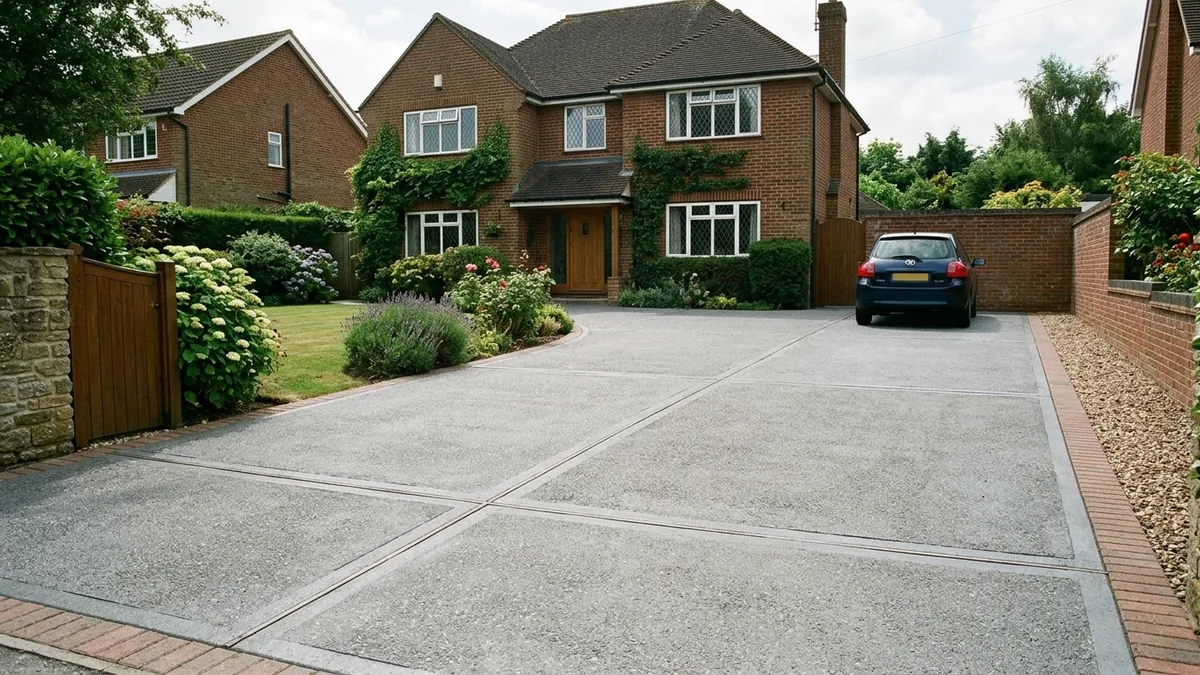
Plain by default. A power-floated grey slab is functional rather than attractive. Brushed, exposed-aggregate and imprinted finishes all address it, at extra cost. Our guide to concrete finishing techniques covers the options.
It is impermeable, so drainage must be planned. Standard concrete sheds water, which brings the front-garden surfacing rules into play. This is entirely manageable but has to be decided before the formwork goes in, not after. See planning permission for a concrete driveway.
It is not instant. You are typically waiting around 7 days before driving on a new slab, and full design strength arrives at 28 days. Gravel is usable immediately.
The Advantages
- Longevity. A correctly laid slab commonly lasts 30 to 40 years or more with very little attention.
- Low maintenance. No weeding between units, no re-sanding joints, no annual topping up.
- Nothing moves. There are no individual units to rock, sink or spread, which is the most common long-term complaint with unbound surfaces.
- Load capacity. A correctly specified slab handles vans and heavier vehicles that would rut gravel and disturb paving.
- Cost per year. Over a long horizon it is usually the cheapest surface to own, even where it is not the cheapest to install.
What Is the Cheapest Driveway Surface?
To install: gravel, clearly. No formwork, no curing, no finishing, minimal labour.
To own: usually concrete. Gravel migrates onto the pavement and into the road, needs topping up every few years, needs edging to stay where it was put, and needs weeding or a membrane below it. Tarmac sits in the middle: cheaper than concrete to lay, shorter life, and it softens in genuine heat.
The honest comparison is cost per year of service rather than the quote. A gravel drive at a fraction of the price that needs attention every couple of years and replacing sooner is not automatically the cheaper option, though for a rarely used or rural drive it very often is the right one.
Does a Driveway Add Value?
Two different questions get mixed together here.
Adding off-street parking where there was none is the change that moves the needle, especially on streets where parking is contested. It also commonly reduces insurance premiums, since a vehicle off the road is a lower risk.
Replacing an existing driveway with a better one is mostly about presentation and saleability. A cracked, weed-strewn drive is the first thing a buyer sees, and fixing it helps a sale more than it moves a valuation.
Be sceptical of fixed percentage uplift figures. The value of off-street parking depends almost entirely on the street: on a road where everyone parks on their own drive it adds little, and on a congested terrace it can be decisive.
How to Avoid the Downsides
Nearly every complaint above traces back to one of four decisions:
- Sub-base. At least 100mm of well compacted hardcore, 150mm where vehicles are heavier. Compacted in layers. Most driveway failures are ground failures. See can you pour concrete onto soil.
- Grade. C25 air-entrained for a UK driveway, stepping up for vans. C20 is doing the bare minimum. Our grades guide covers it.
- Joints. Control joints at sensible spacing, so shrinkage cracks where you chose rather than where it likes.
- Drainage. Decided before the formwork is set, falling to a permeable area within your property.
Get those four right and a concrete driveway is a thirty-year surface that asks almost nothing of you. Get them wrong and it becomes the cautionary tale in someone else's comparison article.
For costs by size see the concrete slab cost guide, for the build sequence see our driveway guide, and to size the pour use the concrete calculator.