Admixture dosage is one of the most commonly misunderstood parts of concrete specification. The question is usually asked as "how much per cubic metre", but that is not actually how dosage works, and getting the basis wrong is how mixes end up over-dosed.
How Is Concrete Admixture Dosage Actually Measured?
Admixture dosage is expressed as a percentage of cement weight, not as a volume per cubic metre of concrete. Typical rates run from around 0.3 to 2.0 percent by cement mass depending on the admixture type.
The reason is chemical. Admixtures act on the cement paste, not on the sand and aggregate that make up most of the volume. Two mixes can both measure one cubic metre while containing very different cement contents, so a flat per-cubic-metre dose would over-dose a lean mix and under-dose a rich one.
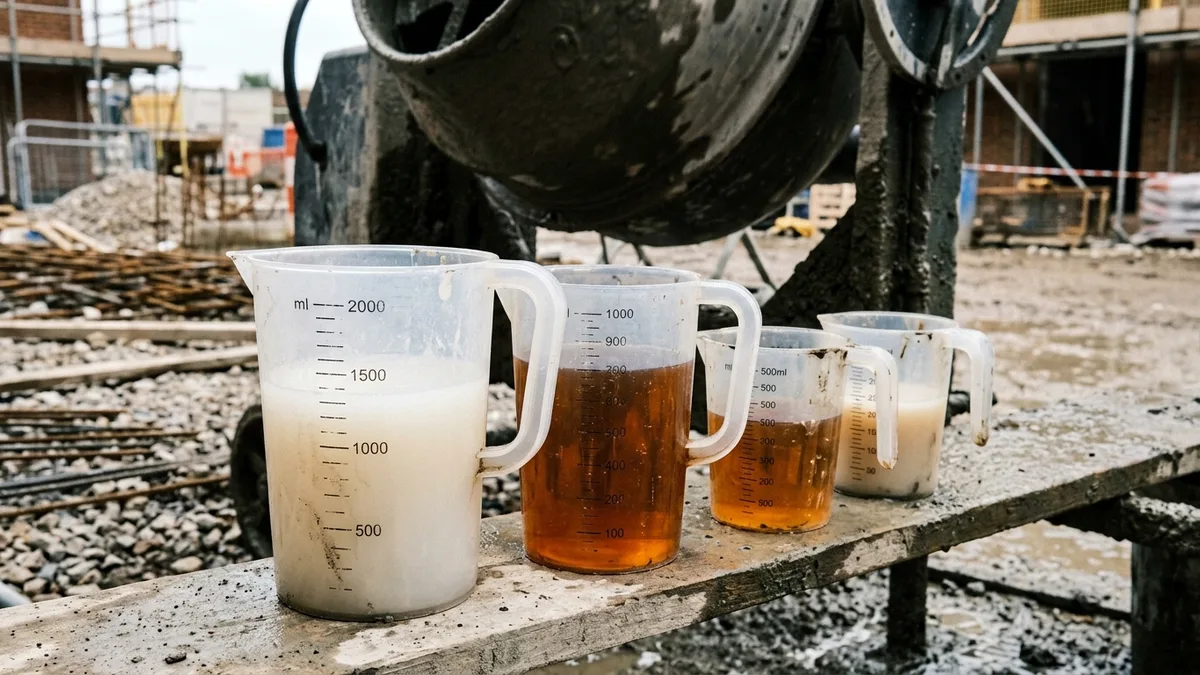
To convert to a practical figure: a cubic metre of concrete typically contains 300 to 400kg of cement. At a 1 percent dose that is 3 to 4kg of admixture, which for most liquid products is roughly 3 to 4 litres. Across the normal dosage range, most admixtures land somewhere between 1 and 8 litres per cubic metre.
What Are the Typical Dosage Rates by Admixture Type?
These are the ranges you will generally see in UK practice. They are indicative, and the manufacturer's data sheet for the specific product always takes precedence over a general figure.
- Plasticisers (water reducers): roughly 0.2 to 0.5 percent of cement weight. Typically reduces water demand by 5 to 12 percent at the same workability.
- Superplasticisers (high-range water reducers): roughly 0.5 to 2.0 percent of cement weight. Water reduction of 15 to 30 percent, and the basis of self-compacting mixes.
- Accelerators: roughly 1.0 to 2.0 percent of cement weight. Higher doses shorten set further but the relationship is not linear and the risk of flash set rises sharply.
- Retarders: roughly 0.2 to 0.5 percent of cement weight. Small changes have a large effect, which is why retarder is the admixture most often over-dosed.
- Air-entraining agents: roughly 0.02 to 0.1 percent of cement weight. The dose is tiny because the target is an air content percentage, usually 4 to 6 percent for UK freeze-thaw exposure, not a volume of product.
For what each of these actually does and when to specify them, see our full guide to concrete admixtures.
What Goes Wrong When Admixture Is Over-Dosed?
More admixture does not mean more benefit. Each type fails in its own way when the dose runs past the recommended range:
- Too much plasticiser causes segregation and bleeding. The paste becomes too fluid to hold the aggregate in suspension, so the stone sinks and a layer of water rises to the surface, leaving a weak, dusty top.
- Too much retarder can delay set for days rather than hours. On a slab poured Friday this is discovered on Monday, and by then the only remedy is time.
- Too much accelerator risks flash setting, where the mix stiffens before it can be properly placed and finished, and can increase shrinkage cracking.
- Too much air-entrainer costs strength directly. As a rule of thumb, compressive strength drops by around 5 percent for each additional 1 percent of entrained air, so an over-aerated mix can miss its design grade.
Under-dosing is generally the safer error, because it simply means the admixture does less than intended rather than actively damaging the mix.
Can You Add Admixture on Site, or Does It Have to Be Batched?
Some plasticisers are formulated for site addition into a truck mixer, followed by a specified period of remixing at full drum speed so the admixture is properly distributed. Many other admixtures are not, because two things are hard to guarantee on site: accurate dosing, and enough mixing energy to disperse the product evenly through the load.
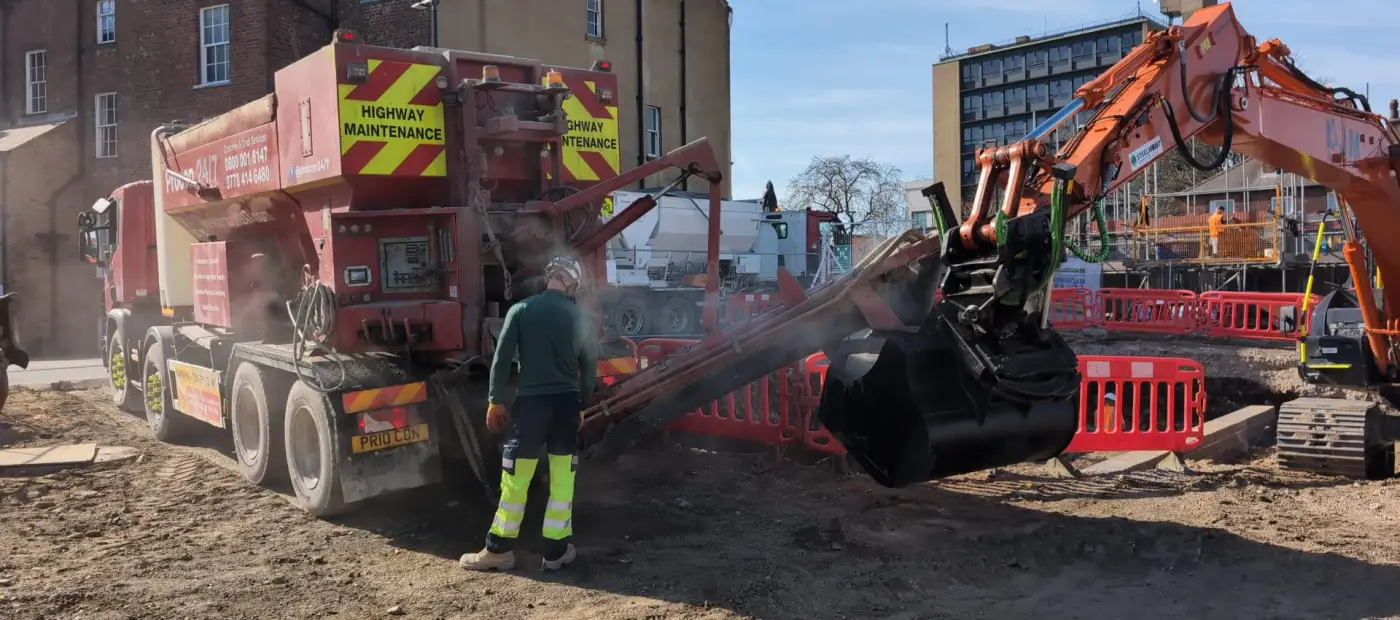
This is one of the practical advantages of volumetric concrete. Because the mix is batched at the point of pour rather than at a plant miles away, admixture dosing happens per batch with calibrated metering, and the mix design can be adjusted between batches on the same visit rather than committed to before the truck leaves.
How Does Weather Change the Dosage Decision?
Temperature does not change the dosage ranges, but it changes which admixture you want and how fast it acts. In cold conditions the concern is a set time that stretches out until the pour cannot be finished in the working day, which is where an accelerator earns its place. See our guide on pouring concrete in cold weather.
In warm conditions the opposite problem appears, with the mix stiffening before it can be placed and finished properly. A retarder buys back the working window. Our guide on concrete in hot weather covers why transit time becomes critical above 25 degrees Celsius.
Either way the same dose behaves differently across the year, which is why the mix design is confirmed against the conditions on the day rather than carried over from the last pour. If you are working out volumes before you order, our concrete calculator will give you the cubic metres, and we will confirm the grade and any admixture requirement at quote stage.