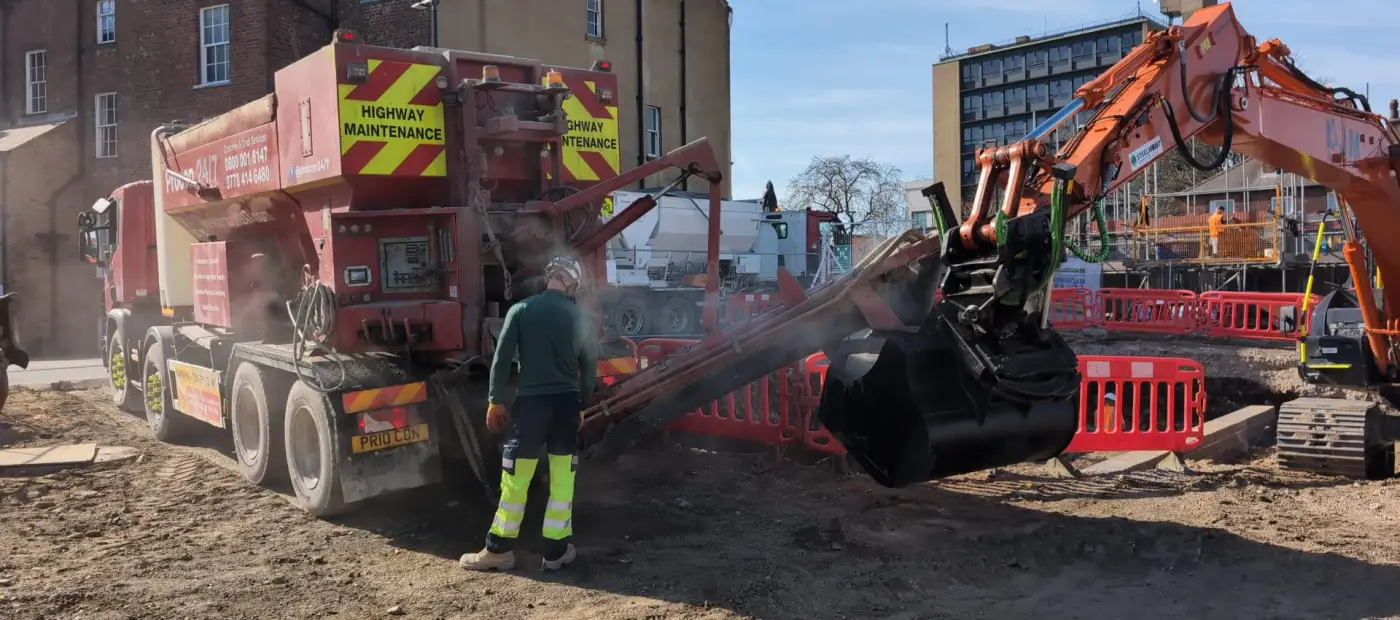
Physically, yes, concrete can be poured onto soil and it will harden. The question is whether it stays flat and intact, and for a slab poured onto topsoil the answer is usually no. Most slab failures are ground failures rather than concrete failures.
Why Pouring Straight Onto Soil Fails
Topsoil is the wrong material to build on for three separate reasons, and they compound.
It compresses unevenly. Topsoil is loose, full of organic matter and voids, and it has never carried load. Under a slab it consolidates, but not uniformly, because the ground beneath is not uniform. The slab bridges the soft spots until it cannot, then cracks.
It holds and moves water. Organic matter retains moisture and wicks it upwards into the underside of the slab. That matters for anything with a floor covering, timber shed bearers or stored items on top.
It moves with the seasons. This is the big one on the clay soils common across much of the UK. Clay shrinks as it dries in summer and swells as it takes up water in winter, and that cycle lifts and drops whatever sits on it. A rigid slab does not accommodate that movement, it cracks along its weakest line.
Organic matter also decomposes over time, leaving voids under a slab that was fully supported when it was poured.
What You Should Do Instead
The sequence is not complicated, and it is most of what separates a slab that lasts thirty years from one that cracks in three:
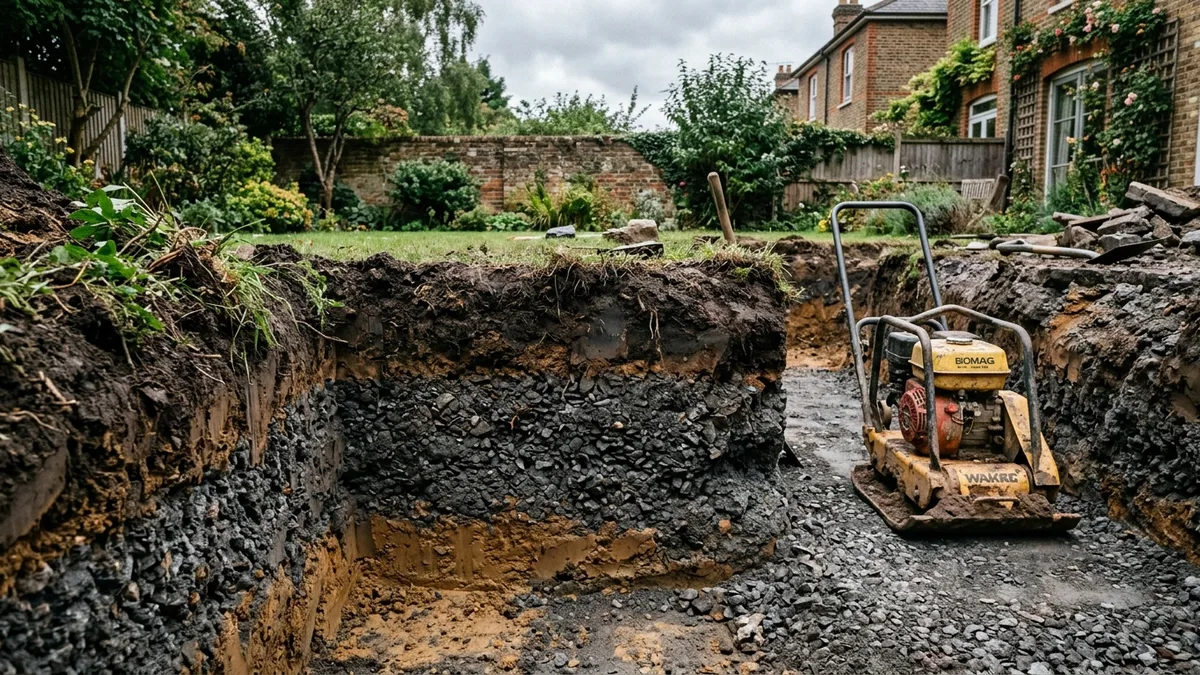
- Strip the topsoil. Dig out turf and topsoil until you reach firm subsoil. Depth varies, but 150 to 300mm is typical before you find ground worth building on.
- Lay hardcore. At least 100mm of MOT Type 1 for domestic slabs, 150mm or more for anything taking vehicles.
- Compact it properly, in layers. A plate compactor over 50mm layers, not 150mm dumped in one go and rolled once. This step is skipped more than any other and it is the one that matters most.
- Blind the surface with sand where the hardcore is sharp enough to puncture a membrane.
- Lay a damp proof membrane for anything internal or carrying a floor finish. 1200 gauge polythene, lapped up the edges.
- Then pour to the specified thickness and grade.
When Concrete Against Soil Is Genuinely Fine
There is a real exception, and it causes some of the confusion. Foundations are poured directly against undisturbed subsoil in the base of a trench, with no hardcore layer at all.
That is correct practice, because the material is completely different. At the bottom of a foundation trench you are on dense, undisturbed subsoil, below the zone of seasonal moisture movement, which is exactly why building regulations set minimum foundation depths. Concrete cast against that ground is fully and evenly supported.
The distinction is undisturbed subsoil at depth versus loose topsoil at the surface. Our guide to concrete for footings and foundations covers depths and grades.
Setting a fence post is the other reasonable case. A post concreted into a hole in the ground is a small, deep, individually supported element, not a slab spanning ground of varying stiffness.
Does a Better Mix Make Up for a Poor Sub-Base?
No, and this is the most expensive misunderstanding on the page. Ordering C35 instead of C25 buys compressive strength, but a slab over a soft spot fails in bending and tension, not compression. A stronger mix on unprepared ground still cracks, it just costs more first.
If the budget is fixed, spend it on the sub-base and the reinforcement rather than the grade. A C25 slab on 150mm of properly compacted hardcore with A142 mesh will outlive a C35 slab poured on topsoil by decades. Our reinforcement guide covers mesh and fibre options, and the shed base guide walks the full sequence.
Once the ground is ready, use our concrete calculator for the volume. Because volumetric mixers batch on site, if the dig takes more than you estimated we simply mix more rather than leaving you short mid-pour.