Cement production accounts for a substantial share of global carbon emissions, and most of that comes from one ingredient: the Portland cement clinker. Finding an alternative is therefore the single highest-leverage change available in concrete specification, which is why the question comes up on more and more UK projects.
Why Look for an Alternative to Portland Cement?
Portland cement is carbon intensive for two separate reasons. The kiln has to reach around 1,450 degrees Celsius, which takes a lot of fuel. But the bigger share, roughly 60 percent of the emissions, comes from the chemistry itself: heating limestone drives carbon dioxide out of the calcium carbonate as it converts to lime. That portion cannot be reduced by switching to a cleaner fuel, because it is released by the reaction rather than by the burner.
That is why substitution matters more than efficiency here. Reducing the amount of clinker in the mix is the only route that addresses the process emissions directly.
What Are the Main Alternatives to Portland Cement?
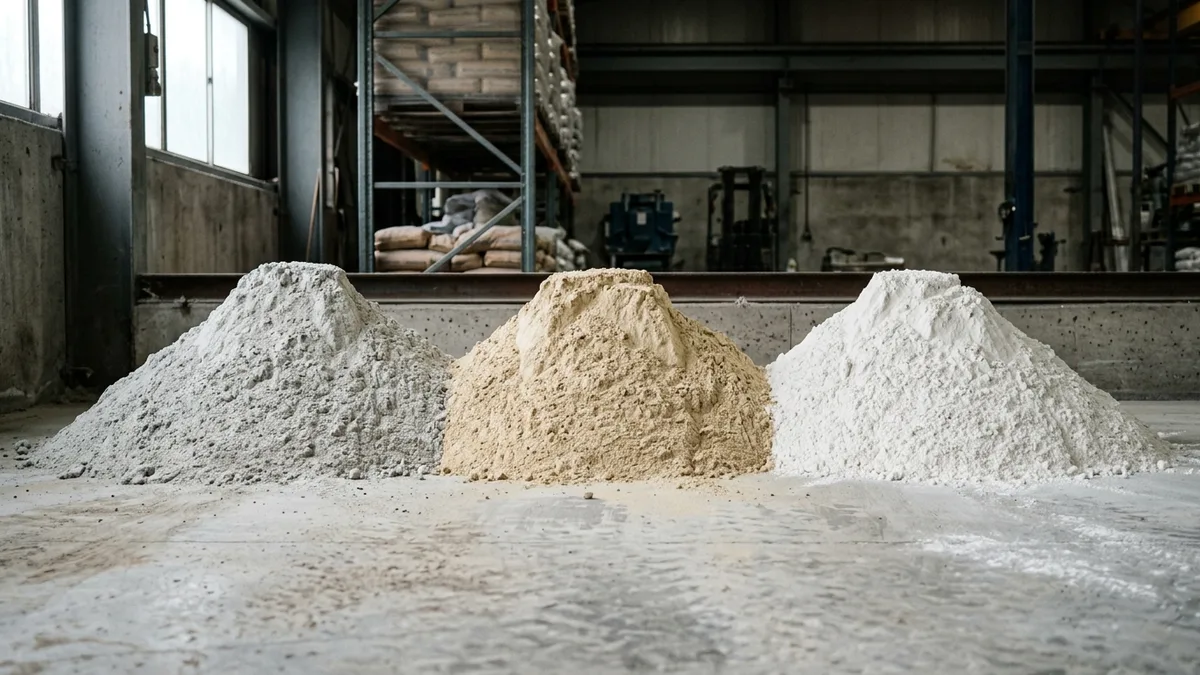
Ground granulated blast furnace slag (GGBS). A by-product of iron production, ground to a fine powder. It is the most established cement replacement in UK construction, commonly used at 30 to 50 percent replacement and higher for specific applications. GGBS mixes gain strength more slowly at early ages but typically match or exceed Portland cement strength by 28 days, and produce a denser, less permeable concrete with better resistance to sulfate attack and chloride ingress. It also generates less heat of hydration, which is why it is favoured for large mass pours where thermal cracking is a risk.
Fly ash, also called pulverised fuel ash (PFA). A by-product of coal-fired power generation, typically used at 20 to 35 percent replacement. It improves workability and long-term durability and reduces heat of hydration. The constraint in the UK is supply: as coal generation has wound down, domestically produced fly ash has become considerably scarcer than it once was.
Limestone fines. Finely ground limestone used as a partial replacement, recognised in UK cement designations. The replacement level is modest compared to GGBS, but it requires no new chemistry and no change in site practice, which makes it one of the easiest reductions to adopt.
Limestone calcined clay cement (LC3). A blend of calcined clay and limestone that can replace a substantial share of clinker. Clay is calcined at a much lower temperature than limestone needs for clinker, so the energy demand and the process emissions both drop. It is well proven in research and increasingly in practice internationally, though less common on UK sites than GGBS today.
Geopolymer and alkali-activated binders. These abandon Portland chemistry altogether, activating aluminosilicate materials such as slag or fly ash with an alkaline solution. Carbon reductions can be large. The barriers are practical rather than theoretical: handling alkaline activators on site, less established UK standards coverage, and a supply chain that is still thin.
What Do You Give Up by Replacing Portland Cement?
The honest answer is early strength, and therefore programme. A GGBS or fly ash mix reaches its design strength at 28 days as normal, but it gets there on a different curve, with less strength at 3 and 7 days than an equivalent Portland cement mix.
On a project that strikes formwork early or loads elements quickly, that difference has to be designed for rather than discovered. In cold weather the effect is more pronounced again, because low temperatures already slow strength gain. Our guide on how long concrete takes to set covers the timings this affects, and the cold weather concreting guide covers the winter case specifically.
The trade also runs the other way. Lower heat of hydration is a genuine advantage on thick sections, and the improved durability of a slag mix in sulfate or chloride exposure is a performance gain, not a compromise.
Are Cement Replacements Permitted Under UK Standards?
Yes. BS 8500 and BS EN 206 both recognise cement combinations containing GGBS and fly ash and specify them by designation, so this is routine specification rather than a special case requiring justification. Sulfate-resisting requirements in particular are frequently met using a slag combination rather than a specialist sulfate-resisting Portland cement.
Where a structural engineer has set the specification, that specification governs. The practical route to a lower-carbon mix is usually to raise it at design stage, when the strength-gain profile can be planned into the programme, rather than to substitute late when the striking times are already fixed.
What Else Reduces the Carbon of a Concrete Pour?
Cement replacement is the largest single lever, but it is not the only one. Recycled aggregates, mix optimisation and repairing rather than replacing existing concrete all contribute, and our guide to eco-friendly concrete alternatives covers those in detail.
The most overlooked reduction is simply not over-ordering. Concrete that is batched and never placed carries its full embodied carbon into a skip. Volumetric supply meters what is actually discharged, so the volume poured is the volume produced. Use our concrete calculator to work out the requirement before you order, and we will confirm the mix, including any cement combination, at quote stage.