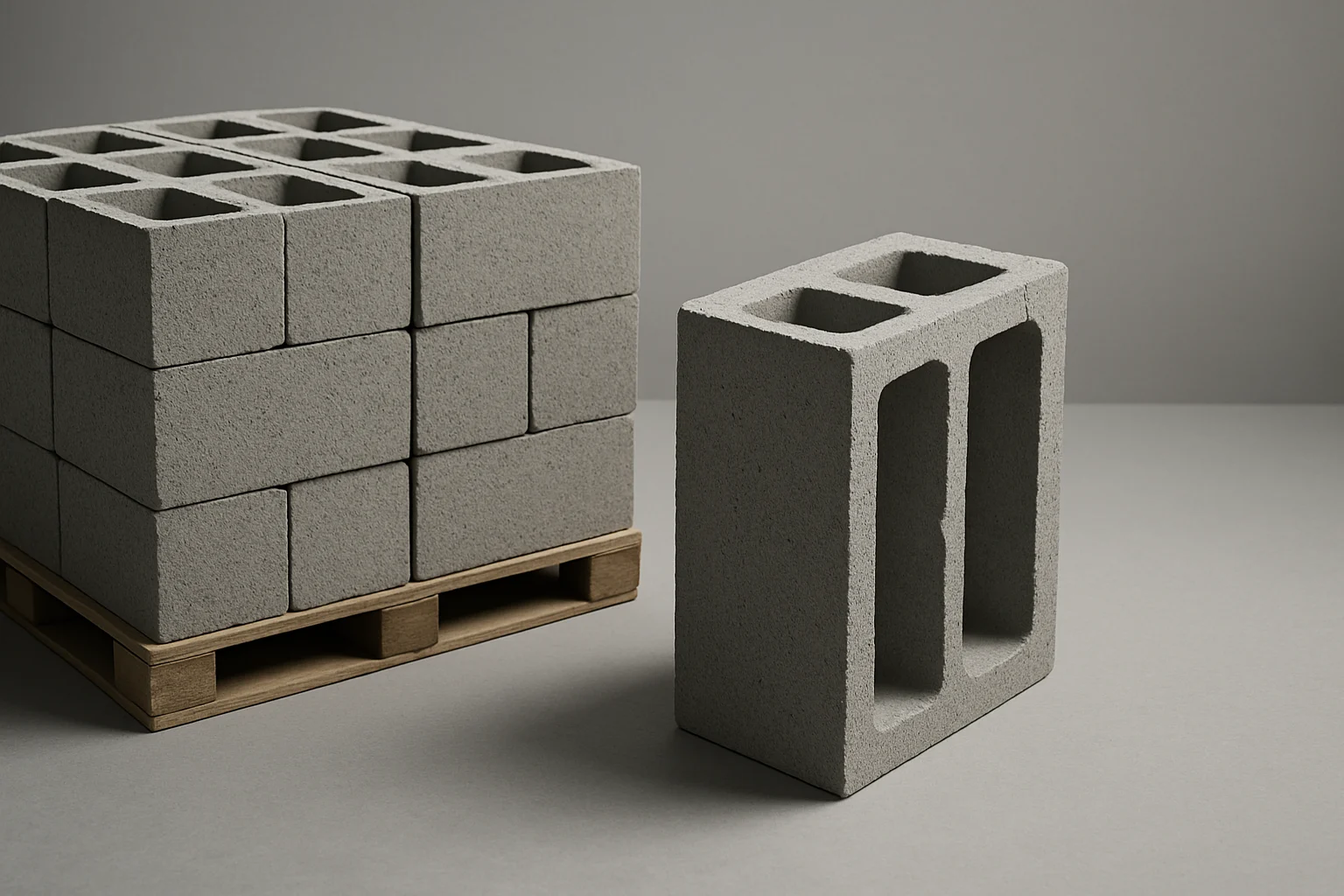
A concrete block is a rectangular masonry unit made from cement, aggregate and water, used to build walls and other structures. In the UK the standard block measures 440mm long by 215mm high, supplied in 100mm, 140mm and 215mm widths. Everything else about a block, its density, strength class, and whether it is solid or hollow, is chosen to suit the wall it is going into.
This guide covers the full size and specification picture, then the types, then how concrete supply fits around blockwork.
Concrete Block Sizes: The UK Standard
Every common UK concrete block shares the same face size of 440 x 215mm. Only the width changes. That single fact is what keeps blockwork compatible with brick coursing and makes quantities easy to calculate.
| Width | Work size (L x H x W) | Approx. imperial | Typical use |
|---|---|---|---|
| 100mm | 440 x 215 x 100mm | 17 3/8 x 8 1/2 x 4 in | Internal partitions, inner and outer leaves of cavity walls, extensions |
| 140mm | 440 x 215 x 140mm | 17 3/8 x 8 1/2 x 5 1/2 in | Heavier loadbearing walls, party walls, improved acoustic and thermal performance |
| 215mm | 440 x 215 x 215mm | 17 3/8 x 8 1/2 x 8 1/2 in | Foundation walls, single-skin structural walls, piers, retaining structures |
Work Size vs Coordinating Size
Merchants quote the work size, which is the physical block: 440 x 215mm. On drawings you will also see the coordinating size of 450 x 225mm, which is the block plus a 10mm mortar joint. The coordinating size is what you build to, and it is why the maths lands so cleanly:
- 0.450m x 0.225m = 0.101 m2 per block including joints
- That gives almost exactly 10 blocks per square metre of wall
- Three courses of standard blockwork match nine courses of brickwork, so the two materials can be tied together in a cavity wall
Allow 5 to 10 percent on top of the raw square metre figure for cuts, breakages and openings.
Other Sizes You May Encounter
440 x 215mm covers the vast majority of UK work, but not all of it. Shorter 215mm and 355mm lengths exist for closing courses and specialist coursing, and 390 x 190mm blocks turn up in imported and specialist ranges. Older buildings may contain imperial blocks that will not course with modern metric units, which matters on extension and repair work.
If you are reading American guidance, note that the US standard is a different unit entirely. A US concrete masonry unit is nominally 8 x 8 x 16 inches, with an actual size of 7 5/8 x 7 5/8 x 15 5/8 inches. It will not course with UK blockwork.
What Is the Difference Between a Concrete Block, Breeze Block, Cinder Block and Cement Block?
Four names, one product. This terminology causes more confusion than any other building materials question in the UK.
Breeze block and cinder block are historical terms for blocks made using industrial waste as the aggregate, specifically furnace clinker (breeze) or coal cinders. Those materials produced lighter units with inconsistent strength, and the products they described are effectively obsolete. Cement block is simply loose usage: cement is one ingredient in concrete, not a separate material.
The modern standard product is the concrete block, made with sand and fine aggregates to a controlled specification. Ask for a breeze block at a merchant today and you will be sold a modern concrete block that comfortably outperforms anything the original name described.
Concrete Block Types by Density
Density is the property that drives weight, strength and insulation together. Choosing the wrong density is the most common blockwork specification error on domestic projects.
| Type | Density | Typical strength | 100mm block weight | Thermal conductivity | Best for |
|---|---|---|---|---|---|
| Lightweight (aerated / aircrete) | Around 1,100 kg/m3 | 3.6 N/mm2 | Around 11kg | Around 0.33 W/mK | Internal partitions, non-loadbearing walls, inner leaf where insulation matters most |
| Medium dense | Around 1,500 kg/m3 | 7.3 N/mm2 | Around 14kg | Around 0.48 W/mK | General walling that needs both loadbearing capacity and reasonable thermal performance |
| Dense | Around 1,960 to 2,050 kg/m3 | 7.3 N/mm2 and above | Around 19kg | Around 1.07 to 1.29 W/mK | Foundations, loadbearing and party walls, exposed external walls, anywhere sound insulation and thermal mass matter |
Dense Concrete Blocks
Dense blocks use standard sand and gravel aggregates, producing heavy, strong units with excellent sound insulation and thermal mass. A 140mm dense block or a 215mm hollow block runs to around 27kg each, which is the point at which two-person handling and lifting plant become a genuine site consideration.
Best for: foundation walls, loadbearing structural walls, party walls between properties, and external walls facing weather or noise. Where mortar-free construction is preferred, interlocking concrete blocks offer a faster alternative for retaining walls, hardstandings and site demarcation without bedding mortar.
Lightweight and Medium Dense Blocks
Lightweight aggregate and aerated blocks use expanded clay, ash, pumice or an aerated cement matrix, cutting weight by 30 to 50 percent against dense blocks while keeping enough strength for non-structural work. Medium dense sits between the two, and is often the sensible default when a wall has to carry load without wrecking the thermal performance of the build-up.
Best for: internal partitions, the inner leaf of cavity walls, upper floors where reducing structural load matters, and any application where insulation takes priority over raw strength.
Concrete Block Strength Classes: 3.6N, 7N and 10N
Block strength is quoted as compressive strength in newtons per square millimetre. Three classes cover most UK work:
- 3.6 N/mm2 for non-loadbearing partitions and internal walls, usually lightweight units
- 7.3 N/mm2, commonly written as 7N, the general-purpose loadbearing block for most housebuilding
- 10.4 N/mm2, written as 10N, for higher structural loads such as multi-storey walls and heavily loaded foundations
The rule that matters: build to the strength on the structural drawings, not to what the merchant happens to have on the yard. Substituting 3.6N for 7N because it was in stock is a defect, not a saving. The same logic applies to the concrete going in around the blockwork, which is covered in our guide to concrete grades and strengths.
Solid, Hollow and Cellular Blocks
Blocks come in three formats. Solid blocks are exactly that. Hollow blocks have cores running right through. Cellular blocks have recesses closed at one end, so they present a solid face on the top course.
Why Do Concrete Blocks Have Holes?
The cores are engineering, not cost-cutting:
Weight reduction: a solid 215mm block would be close to unmanageable by hand. Coring it out brings a 215mm unit down to roughly the same 27kg as a 140mm solid block, which keeps it liftable.
Thermal performance: the trapped air in the cores reduces heat transfer compared with solid concrete of the same width.
Structural reinforcement: the big one. Fill the cores with concrete and steel reinforcement bar and a hollow block wall becomes reinforced concrete, capable of carrying serious structural load. This is where blockwork and poured concrete meet on the same job.
Working Out Fill Volume
A 440 x 215 x 215mm block has a gross volume of 0.0203 m3. Hollow units are typically somewhere between a third and half void, so budget roughly 0.007 to 0.010 m3 of fill concrete per block and confirm the exact void ratio against your supplier's data sheet before ordering. Over a wall of any size that difference is worth checking rather than estimating. Our free concrete calculator converts wall dimensions into a delivery volume.
Where Concrete Supply Meets Blockwork
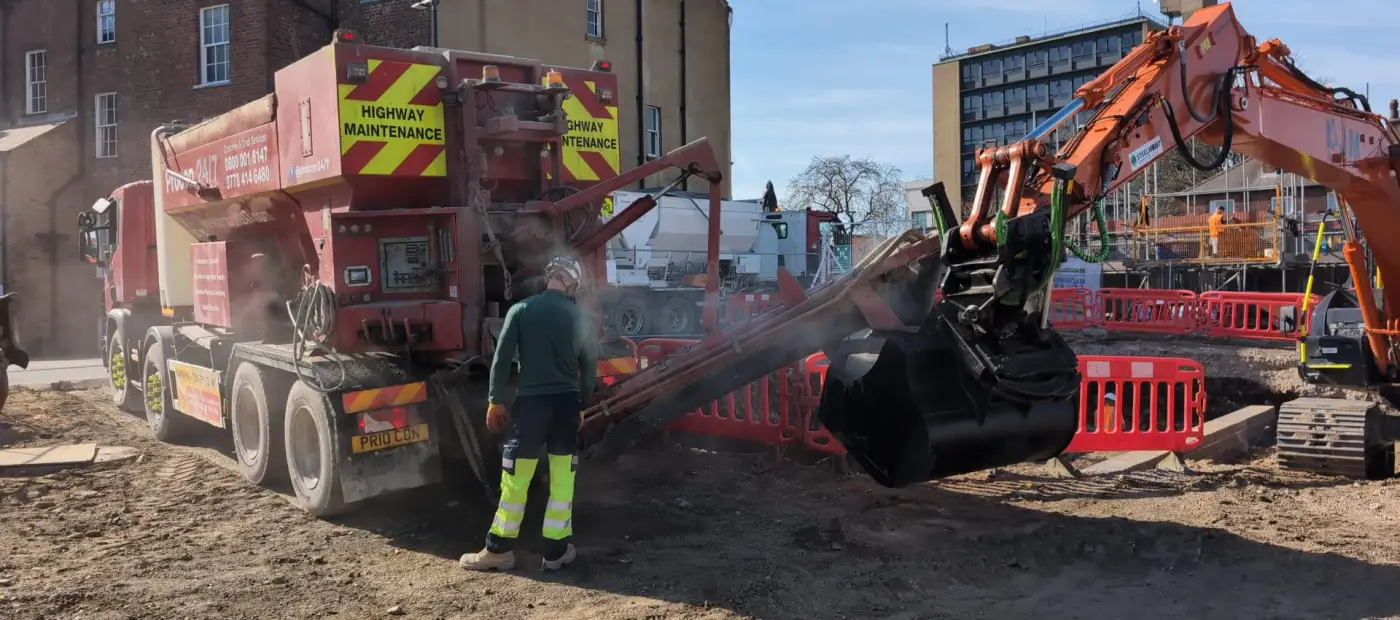
Blocks are a manufactured product bought from a merchant. The concrete around them is not. Core fill, foundations, footings, lintel bearings and slabs all have to be supplied at the right grade, and volumetric delivery means you take only what the wall actually consumes rather than paying for a rounded-up drum.
For filling hollow cores or pouring the foundations underneath, our domestic concrete service covers residential projects across Yorkshire and the North West, and our commercial concrete service handles larger structural work. Our ready-mix concrete service supplies the correct grade for any block-filling application.
Frequently Asked Questions About Concrete Blocks
What is the standard size of a concrete block in the UK?
440mm long by 215mm high, in 100mm, 140mm or 215mm widths. With a 10mm mortar joint the coordinating size is 450 x 225mm, which gives 10 blocks per square metre.
What are the dimensions of a 100mm concrete block?
440 x 215 x 100mm, roughly 17 3/8 x 8 1/2 x 4 inches. It is the most widely used width in UK housebuilding, found in internal partitions and in both leaves of a cavity wall.
What is the difference between 7N and 10N concrete blocks?
Compressive strength. 7N (7.3 N/mm2) covers most general loadbearing walling; 10N (10.4 N/mm2) is specified where structural loads are higher, such as multi-storey work or heavily loaded foundations. 3.6N blocks are for non-loadbearing partitions. Build to the drawings, not to what is in stock.
How much does a concrete block weigh?
A 100mm lightweight block is around 11kg, medium dense around 14kg, and solid dense around 19kg. A 140mm solid dense block or a 215mm hollow block is roughly 27kg.
How many concrete blocks per square metre?
Ten, for standard 440 x 215mm blocks with 10mm joints. Add 5 to 10 percent for cuts, breakages and openings.
Are concrete blocks and cement blocks the same thing?
Yes. Cement is an ingredient of concrete, not a separate material. Breeze block and cinder block are older names for the same category of product.
How many concrete blocks are on a pallet?
Typically 32 to 90, depending on block width and density. Dense and wider blocks pack in smaller counts because of weight limits; lightweight 100mm blocks pack in higher numbers.
Is concrete block cheaper than brick?
Usually, per square metre of wall. One block face covers roughly the same area as six bricks and lays far faster, cutting both material and labour cost. Brick is chosen where the finished face is on show, which is why many walls pair a block inner leaf with a brick outer leaf.
Can you paint concrete blocks directly?
Yes, but preparation matters. Clean the blocks thoroughly and apply a masonry primer before the finish coat. The porous surface often needs multiple coats for even coverage.
Are concrete blocks waterproof?
No. Standard blocks are porous and will absorb moisture. For basements, retaining walls or below-ground work, use rendered and sealed blocks or specify a waterproof mix for the surrounding poured concrete. See our full guide on whether concrete blocks are waterproof for treatment methods.
What concrete should I use to fill hollow concrete blocks?
C20 or C25 with good workability suits most block-filling. For structural reinforced block walls your engineer will specify the grade. Our team can advise on the right mix, or use the concrete calculator for volumes.