Traditional concrete production generates substantial CO2 emissions: approximately 8% of global carbon emissions through cement manufacturing. For environmentally conscious builders, this creates a genuine question: how do you balance concrete's structural benefits with the need for more sustainable construction? The answer isn't to abandon concrete. It's to build smarter with greener concrete solutions, proven alternatives to Portland cement, and sound materials science.
What Are Supplementary Cementitious Materials (SCMs) in Concrete?
Supplementary Cementitious Materials (SCMs) represent one of the most significant breakthroughs in low-carbon concrete. These materials allow substantial portions of traditional Portland cement to be replaced with recycled industrial byproducts that would otherwise require disposal. Our guide to alternatives to Portland cement compares each option and what it costs you in early strength.
Fly ash (a byproduct of coal-fired power stations) can replace up to 30% of cement in concrete mixes, often improving workability and long-term strength. Ground Granulated Blast-furnace Slag (GGBS), derived from iron production, can replace even higher percentages whilst delivering excellent durability. Modern concrete mixes using SCMs can reduce embodied carbon by 40–60% compared to standard Portland cement, a substantial step forward for sustainable construction in Yorkshire, the North West, and across the UK.
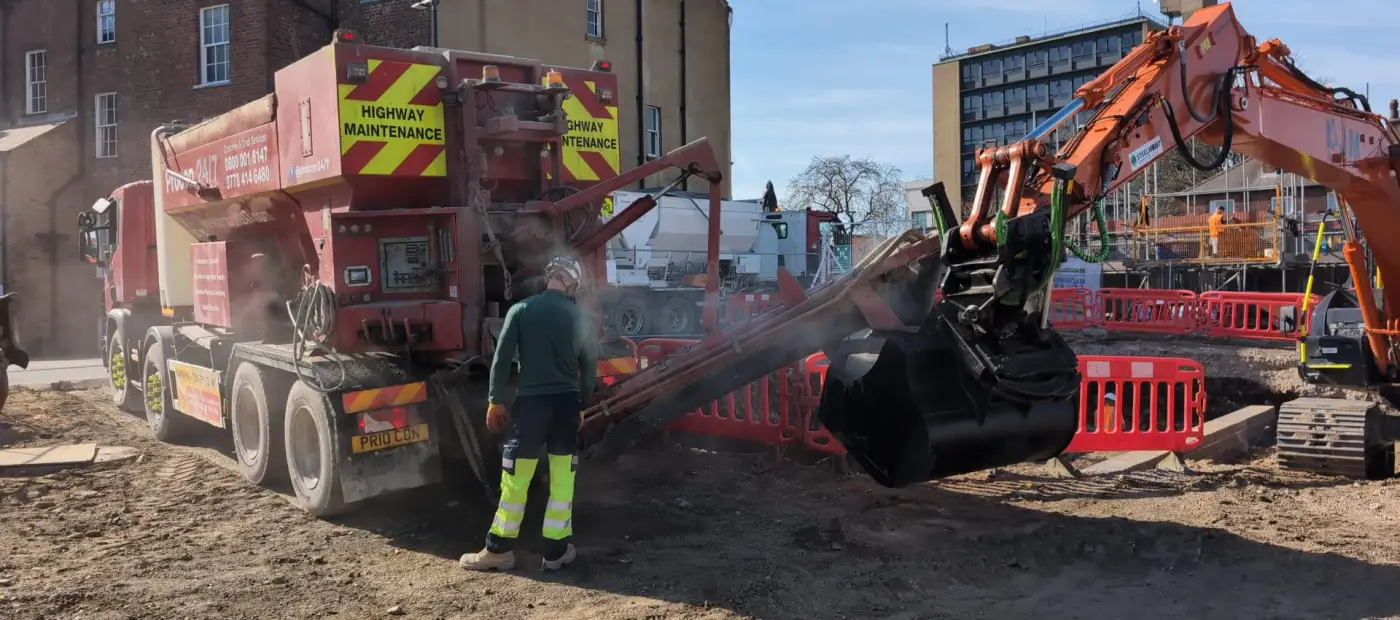
Procon 24/7's volumetric concrete service is particularly well-suited for sustainable specification: admixtures and SCM ratios can be adjusted on-site at the point of pour, rather than being locked in at a remote batching plant. This flexibility means every project can be spec'd for the right environmental performance. Our ready-mix concrete is also available in GGBS-blended mixes for reduced-carbon applications.
Can Recycled Concrete Aggregates Replace Virgin Materials?
The aggregates industry has embraced circular economy principles. Crushed concrete from demolition sites can effectively replace virgin aggregates in new concrete production, reducing both landfill waste and quarrying demand.
Recycled concrete aggregates (RCA) perform excellently in many applications, particularly sub-base materials, non-structural concrete, and certain structural applications where specifications permit. The process involves crushing demolished concrete, removing contaminants, and grading to meet specification requirements. Quality recycled aggregates often match or exceed virgin material performance whilst delivering meaningful environmental benefits through reduced transportation distances and eliminated quarrying impacts.
Our blog post on whether concrete can be recycled covers the full process and limitations in detail.
What Other Sustainable Building Materials Work Alongside Concrete?
Whilst greener concrete handles most structural needs, several materials excel in specific circumstances where environmental considerations take priority.
Permeable pavers offer excellent solutions for driveways, car parks, and pedestrian areas where drainage management matters. They reduce surface water runoff, prevent flooding, and often incorporate recycled materials. They work particularly well where Sustainable Urban Drainage Systems (SUDS) compliance is required.
Foamed concrete is worth considering for void-filling, trench reinstatement, and insulation applications. Procon 24/7's foamed concrete service delivers lightweight, flowable material that uses significantly less cement per cubic metre than standard mixes, making it an inherently lower-carbon choice for suitable applications.
Timber construction using sustainably sourced or engineered timber provides low-carbon alternatives for structural applications in residential and light commercial construction. Cross-laminated timber (CLT) offers impressive structural capabilities with much lower embodied carbon than concrete, though it cannot match concrete's durability or fire resistance in all contexts.
Is Repairing Existing Concrete More Eco-Friendly Than Replacing It?
The most profound environmental impact often comes from the materials we don't need to create. Repairing existing concrete rather than replacing it is frequently the most sustainable decision on site.
Modern techniques like concrete lifting can restore sunken or uneven slabs for a fraction of the environmental impact of demolition and replacement. Rather than disposing of structurally sound concrete and manufacturing new material, lifting injects polyurethane foam to re-level surfaces whilst extending their service life by decades.
Concrete repair and restoration technologies have advanced significantly: surface treatments, crack injection, and structural strengthening can restore performance at minimal environmental cost. This approach aligns perfectly with circular economy principles by maximising existing material value. Use our concrete calculator to estimate material volumes before committing to any pour, helping minimise waste from the outset.
Frequently Asked Questions About Eco-Friendly Concrete
How much can carbon-reduced concrete lower a project's environmental impact?
Carbon-reduced concrete using SCMs like fly ash and GGBS can reduce embodied carbon by 40–60% compared to standard Portland cement mixes. The exact reduction depends on replacement percentages and the specific SCMs used in the mix design.
Are recycled concrete aggregates as strong as virgin materials?
Quality recycled concrete aggregates often match virgin aggregate performance for many applications, including sub-base materials and non-structural concrete. There are restrictions for high-strength structural applications. Always check specifications before substituting.
What's the most environmentally friendly option for a driveway?
For driveways, consider permeable concrete or high-SCM-content mixes for maximum durability with lower carbon. If your existing driveway has minor cracking or settlement, repair and restoration typically offers a lower environmental impact than full replacement.
Can Procon 24/7 supply low-carbon concrete mixes?
Yes. Our volumetric concrete service allows GGBS and fly ash blends to be specified and adjusted at the point of pour, and our ready-mix concrete is available in reduced-carbon formulations. Contact our team to discuss the right specification for your project across Yorkshire and the North West.
What is the best alternative to Portland cement?
There is no single best alternative to Portland cement, it depends on the application. GGBS (Ground Granulated Blast-furnace Slag) suits higher-replacement, high-durability mixes. Fly ash suits general-purpose replacement with improved workability. Both are proven, widely available SCMs in the UK rather than experimental materials, and both are available through Procon 24/7's ready-mix and volumetric concrete.