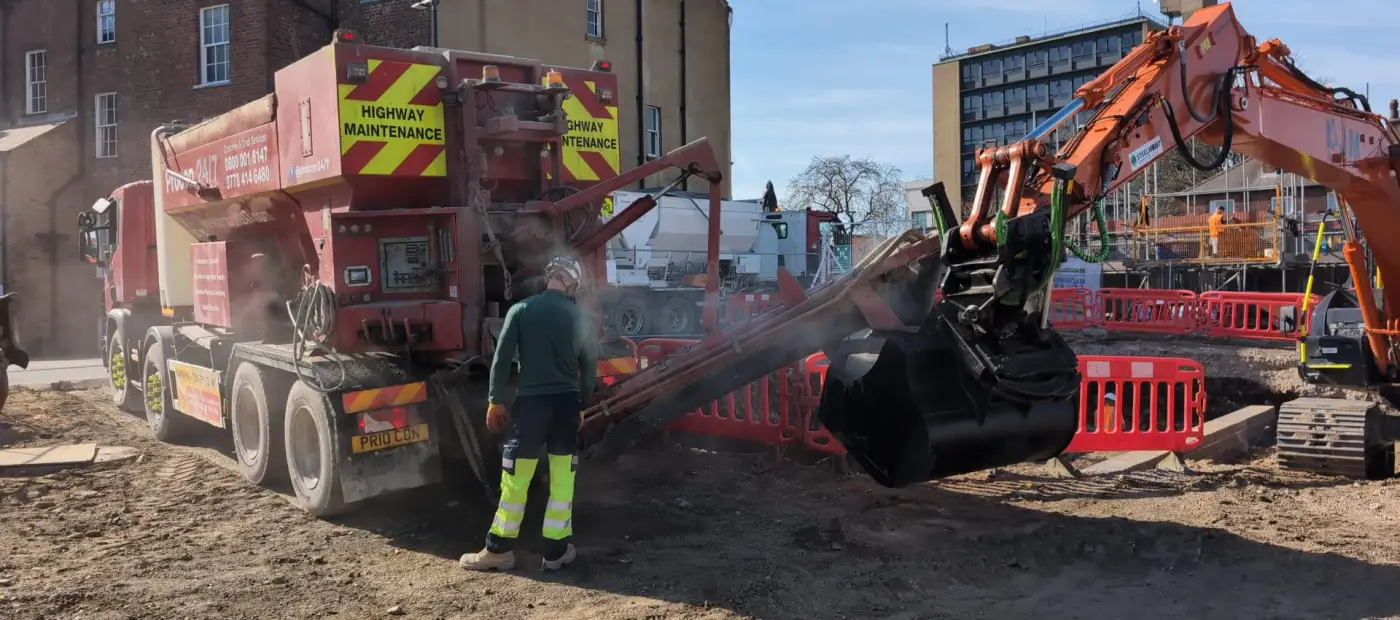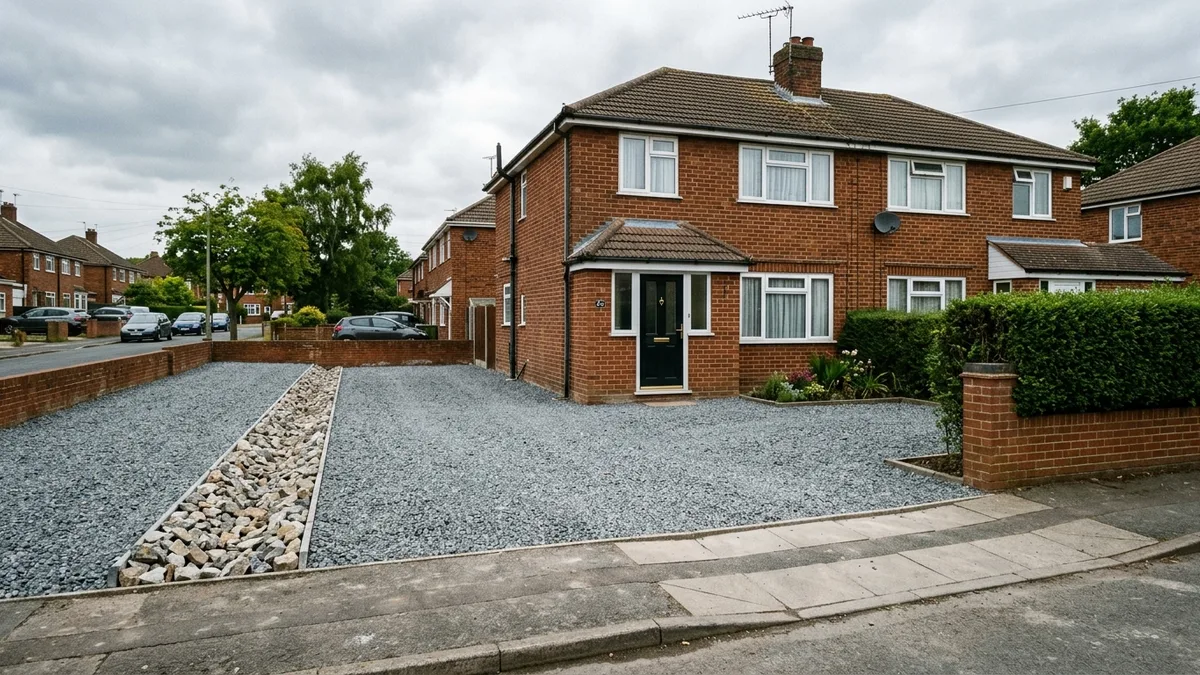
This is one of the most common questions homeowners ask before a driveway pour, and the answer online is usually either wrong or alarming. The short version: most concrete driveways can be laid without planning permission, but only if the drainage is handled properly, and that decision has to be made before the pour rather than after.
What the Rule Actually Says
In England, since October 2008, laying more than five square metres of impermeable surfacing in a front garden requires planning permission if the surface water runs off onto the road.
Three conditions have to be met together for permission to be needed, and that is the part usually lost in the summary:
- Front garden. The rule covers land between the house and the highway. Rear and side gardens are not caught by it.
- Over five square metres. Below that threshold it does not apply.
- Impermeable, draining to the highway. This is the condition you control, and it is the one that decides most jobs.
Manage the water inside your own boundary and the work falls under permitted development. That is why the great majority of concrete driveways are laid without a planning application.
It is also worth saying plainly: despite how often you see it framed as a new 2026 rule, this has been in force since 2008. If an article is selling urgency about a rule change, it is selling something.
Why Concrete Specifically Triggers the Question
Standard concrete is impermeable. Water does not pass through it, which is exactly what you want from a slab and exactly what brings this rule into play.
The rule exists because of surface water flooding. When enough front gardens across a street are paved in something water cannot pass through, rainfall that used to soak into soil arrives at the drainage network all at once. The 2008 change was a response to that cumulative effect, not to any individual driveway.
Porous and no-fines concrete do exist and genuinely allow water through, but they are specialist mixes with different strength and finish characteristics, not the standard driveway pour. For most projects the practical answer is standard concrete plus a drainage route.
The Three Compliant Routes
1. Direct the runoff into your own garden. The simplest and most common approach. Lay the driveway to fall towards a lawn, planted border, or gravel margin inside your boundary rather than towards the pavement. No application needed. It costs almost nothing if it is planned before the formwork goes in, and it is awkward and expensive to retrofit afterwards, which is the practical reason to settle this early.
2. Install a soakaway or permeable drainage channel. Where the ground falls the wrong way or there is no soft landscaping to drain to, a channel drain across the driveway entrance feeding a soakaway does the same job. The soakaway must be sized for the area and suited to the ground: heavy clay drains slowly, so it needs designing rather than guessing.
3. Use permeable surfacing. Permeable surfacing of any size is permitted development. Gravel, porous asphalt and permeable block paving all qualify. This route trades away the continuous, low-maintenance surface that makes concrete attractive in the first place, so it is worth weighing against the drainage options above. Our comparison of concrete against paving slabs covers that trade in cost terms.
The Approval Everyone Forgets: the Dropped Kerb
Planning permission for the surface is a separate matter from being allowed to drive onto it.
If a vehicle will cross the footway to reach your new driveway, you need a dropped kerb, also called a vehicle crossover. That is applied for through your local highway authority, and it applies regardless of what you surface the driveway with. Permeable gravel does not exempt you.
Applications are assessed on sightlines, proximity to junctions, street furniture such as lamp posts and drain gullies, and whether there is enough depth on the plot for a vehicle to stand clear of the footway. It is worth confirming a crossover is achievable before committing to the driveway, because a beautifully finished slab you cannot legally drive onto is an expensive outcome.
Driving over a full-height kerb without a crossover is an offence and can crack the footway and damage buried services underneath.
Other Constraints Worth Checking
- Listed buildings. Listed building consent may be needed, and permitted development rights are far more limited.
- Conservation areas. Permitted development rights can be restricted, and materials may be controlled.
- Article 4 directions. These remove permitted development rights in a defined area. Your local planning authority will confirm whether one applies to your street.
- New-build estate covenants. These are private contractual restrictions, entirely separate from planning, and they routinely control driveway alterations.
- Trees. A protected tree, or any tree in a conservation area, brings separate rules, and excavating through a root protection area is a genuine problem rather than a formality.
What to Do Before You Order Concrete
- Decide where the water will go, and make sure it is somewhere inside your boundary.
- Check whether your property is listed, in a conservation area, or covered by an Article 4 direction.
- Apply for a dropped kerb if the vehicle will cross the footway.
- Ring your local planning authority if any of the above is unclear. It is a short call and it is free.
- Then work out the volume with our concrete calculator and book the pour.
None of this is a reason to avoid a concrete driveway. It is a reason to plan the fall of the slab before the formwork is set, which costs nothing at that stage. Our driveway construction guide covers the build itself, and the slab cost guide covers the numbers.
This page is general guidance on how the rules work, not legal advice on your specific property. Your local planning authority is the authority on your address, and confirming with them before you start is always the right move.