Basement concrete block walls sit permanently below ground, facing constant hydrostatic pressure from groundwater rather than occasional rain. This changes the waterproofing approach significantly compared to an above-ground garden or boundary wall. This guide covers what makes basement waterproofing different, and how to specify a system that actually keeps a basement dry.
For general concrete block waterproofing methods, see our full guide to whether concrete blocks are waterproof. This guide focuses specifically on the below-ground case.
Why Is Basement Waterproofing Different?
Above ground, a concrete block wall faces intermittent rain and its own weight pushing water away by gravity. Below ground, groundwater pushes continuously against the wall from all sides, a force called hydrostatic pressure that increases with depth. A coating rated for a garden wall will not hold back a basement's water pressure over time, which is why basement systems specify cementitious coatings or membranes rather than lighter sealants and paints.
What System Should You Use for a Basement?
Cementitious coatings are the standard choice for most basement conversions. Cement-based slurries trowelled on like thick render, they bond chemically with the block substrate and cure to form an integral, rigid barrier capable of resisting significant hydrostatic pressure.
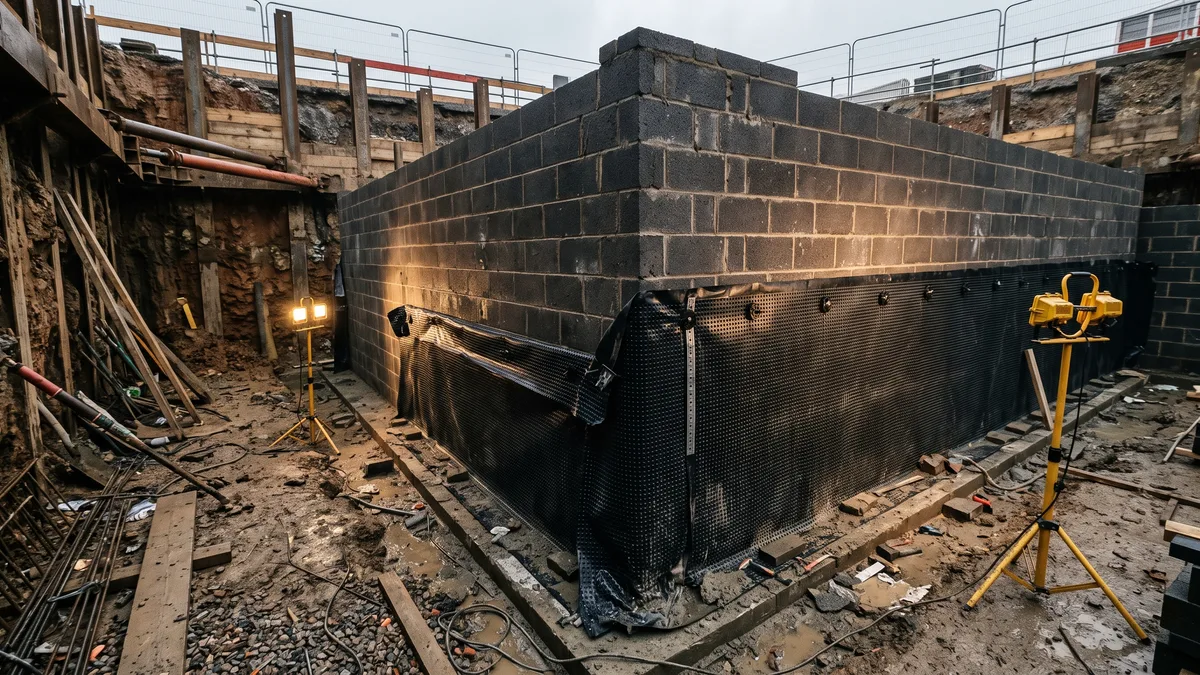
Membrane systems go further for the most demanding sites, particularly where the water table is high or where a habitable basement conversion needs to meet a higher standard of dryness. Sheet or liquid-applied membranes stop water reaching the block at all, rather than managing it once it arrives.
Positive Side vs Negative Side: Which Matters More in a Basement?
Exterior (positive side) waterproofing is always the stronger approach when the basement is accessible during construction or a full excavation, since it prevents water from entering the block structure entirely. Interior (negative side) waterproofing manages water that has already penetrated, which is the only realistic option on an existing, already-backfilled basement without full excavation, but it does not stop the underlying moisture ingress into the block itself.
Does Drainage Matter as Much as the Coating?
Yes. A waterproofing coating and a drainage strategy work together, not as alternatives. A perimeter drainage channel (a French drain or cavity drainage membrane system) directs water away from the wall before it builds up pressure, and a sump pump handles any water that does collect at the base. Sites with a high water table typically need all three elements: coating, drainage, and pumped removal.
Frequently Asked Questions
Do I need a sump pump if I waterproof my basement walls?
It depends on the water table and drainage design. A cementitious coating or membrane stops water at the wall, but if the site has a high water table, a sump pump and perimeter drainage channel are usually specified alongside the wall treatment as a combined system, not an alternative to it.
Can basement waterproofing be applied from the inside only?
Yes, but it manages water that has already reached the wall rather than preventing it from entering the block structure. Exterior (positive side) waterproofing is always preferable when the basement is accessible during construction, since it stops water before it reaches the blocks at all.
What is hydrostatic pressure and why does it matter for basements?
Hydrostatic pressure is the force exerted by groundwater against a below-ground wall. It increases with depth and can force water through even a well-built block wall if the waterproofing system is not rated for it. This is why basement systems differ from above-ground wall treatments.
Does Procon 24/7 supply concrete for basement construction?
Yes. Our commercial and domestic concrete services include waterproof admixture mixes for basement floor slabs and retaining walls, specified at the point of pour to reduce permeability at source, alongside any surface waterproofing system applied to the blockwork.
Specify the Right Concrete From the Start
A dry basement starts with the concrete itself, not just the surface coating. Procon 24/7's commercial concrete and domestic concrete services include waterproof admixture mixes for basement slabs and retaining walls across Yorkshire and the North West.